



NAIROBI, Kenya – The question that has always been lingering on the minds of many people, especially wildlife enthusiasts, is whether giraffes have horns.
We finally got the answer: Giraffes have ossicones, not horns!
According to the World Wild Fund for Nature-Kenya, these fascinating structures are made of ossified cartilage covered in skin and fur—a unique feature that sets them apart.
“Both male and female giraffes have ossicones, but males develop thicker, more pronounced ones, often sporting a tuft of hair on top,” reads a statement from the World Wild Fund for Nature-Kenya.
These structures serve important functions beyond their striking appearance.
It has been established that male giraffes use their ossicones as weapons during a behaviour known as necking, where they swing their long necks to strike opponents in battles for dominance and mating rights.
World Wild Fund for Nature-Kenya disclosed that the size and thickness of the ossicones can be an advantage in these contests, helping the stronger male establish its position in the social hierarchy.
Scientists speculate that ossicones also play a role in thermoregulation.
Scientists say that the network of blood vessels within them helps dissipate heat, allowing giraffes to regulate their body temperature in the scorching savannah.

Did you know that giraffes’ stripes are unique like human fingerprints? Some fun facts here ! @KWSKenya
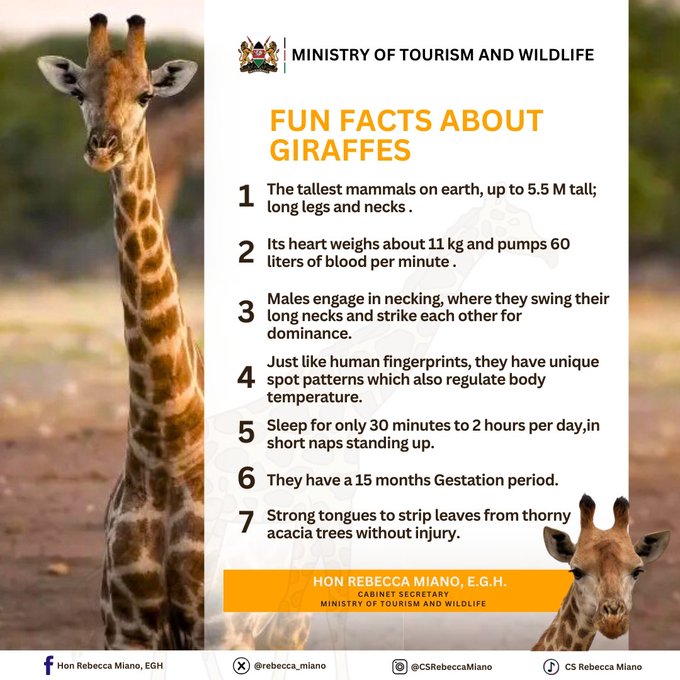
This natural cooling system is particularly beneficial given its large size and exposure to direct sunlight for extended periods.
Beyond their functional benefits, ossicones contribute to the giraffe’s unmistakable silhouette, making them one of the most recognizable animals on the planet.
“Much like a human fingerprint, every giraffe has a unique coat pattern, and their ossicones add an extra touch of individuality to their graceful stature,” the scientists say.
These gentle giants continue to captivate researchers and wildlife enthusiasts alike, reminding us of the intricate adaptations that make each species unique.
More information about giraffes
Meanwhile, there are three subspecies of giraffes in Kenya, namely, Maasai, Reticulated, and Rothschild’s/Nubian.
The reticulated giraffe was added to the IUCN Red List in 2018 as endangered because of a continuing decline of 56% over the last 30 years.
The decline is linked to habitat loss, deterioration of habitat quality, and illegal killing/poaching.
On the other hand, the reticulated giraffes are found not only in the north and east of Kenya but also in southern Ethiopia and southwestern Somalia.




