



NAIROBI, Kenya- The Central Organisation of Trade Unions (COTU–K) Secretary General, Francis Atwoli, has demanded the immediate deportation of a Chinese national filmed assaulting a Kenyan worker at a mabati factory.
The disturbing video, which spread widely on social media, shows the Chinese man kicking the worker and at one point striking him with an iron sheet as colleagues urge the victim to fight back.
The footage has triggered widespread public anger and renewed debate about the treatment of Kenyan workers in foreign-owned companies.

A Worker in Eldoret being harassed by a Chinese.We are not angry enough as Kenyans
A separate video surfaced shortly after, showing the same Kenyan employee shaking hands with his boss.
“I have forgiven him,” the worker said, adding that he was willing to continue with his job.
“Next time, if there is a problem, we should just meet in the office and sort out any issues.”

Kenyan man filmed being harassed by a Chinese employer says he has forgiven him and wishes to continue working there.
But Atwoli insists the matter cannot be dismissed with a handshake.
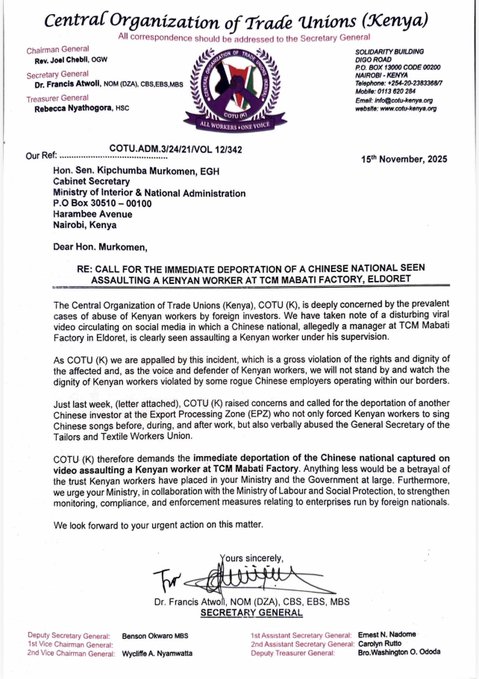
“COTU(K) demands the immediate deportation of the Chinese national captured on video assaulting a Kenyan worker at TCM Mabati factory,” he said in a statement addressed to Interior Cabinet Secretary Kipchumba Murkomen.
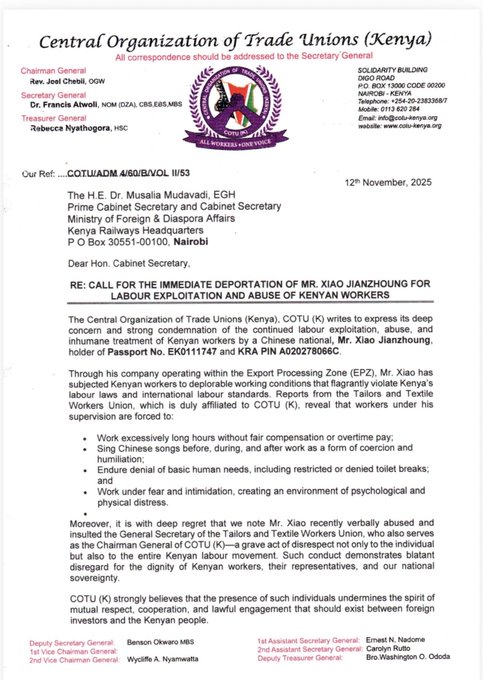
He also called for the removal of “all rogue Chinese investors … who force Kenyans to sing Chinese songs,” arguing that the dignity of Kenyan workers must be protected.

Dear CS @kipmurkomen,COTU (K) demands the immediate deportation of the Chinese national captured on video assaulting a Kenyan worker at TCM Mabati Factory. We also call upon you to deport other rogue Chinese investors including those running some entities in EPZ who force
His remarks have reignited long-standing concerns about labour practices in some Chinese-owned companies operating in the country.
Trade unions and labour activists have consistently highlighted cases of exploitation, poor working conditions, and unfair labour relations involving foreign employers.
In 2024, the Employment and Labour Relations Court ruled against China Young Tai Engineering Co. Ltd in a case filed by a Kenyan employee who described enduring years of harassment and an abusive work environment.
The court found that the company had denied the worker overtime, leave days, and retirement benefits, underscoring the wider concerns around labour rights violations.
Studies have painted a similar picture. University of Nairobi research has shown that Kenyan workers in some Chinese-run construction firms earn significantly less and operate under harsher conditions compared to their counterparts in local companies.
Other investigations have documented instances of degrading treatment, inadequate safety measures, and discriminatory workplace practices.
Past incidents have forced government intervention. In one notable case, four Chinese nationals were deported after they were accused of assaulting a Kenyan restaurant worker with a cane, sparking national outrage.
While Atwoli’s call for deportation stems from frustrations that many Kenyan workers share, it also highlights deeper questions about how effectively the government monitors foreign investors, enforces labour laws, and safeguards workers’ rights.
Viral incidents like this often expose gaps in regulation and oversight.
COTU and other labour advocates are now pushing for stronger inspections, tighter immigration controls, and the incorporation of workers’ rights into broader trade and investment policies.


