



NAIROBI, Kenya — The Police Reforms Working Group Kenya (PRWG-K) has strongly condemned the transfer of police officers implicated in the brutalisation of civilians in Nandi County, warning that the move entrenches systemic impunity within the National Police Service (NPS).
In a statement issued on Monday, the alliance of civil society organisations said administrative transfers cannot substitute accountability and risk spreading abusive conduct to new communities.
“The decision to transfer officers implicated in brutality is not accountability. It reinforces a culture of impunity and undermines public confidence in policing,” PRWG-K said.
The group argued that the Nandi incident reflects a broader national pattern, citing similar allegations of excessive force across several counties. It said these cases expose persistent gaps in supervision, discipline, and enforcement within the police service.
Under the National Police Service Act, PRWG-K noted, allegations of excessive force and abuse of authority must trigger prompt investigations and, where appropriate, interdiction or suspension.
“Moving officers accused of violence without due process creates barriers for victims seeking justice and signals tolerance for brutality,” the statement said.

Press statement: PRWG-K condemns the transfer of officers implicated in Nandi brutality, warns of systemic impunity and command responsibility failures. Police reform requires independent oversight, firm disciplinary action, and adherence to constitutional and legal standards.
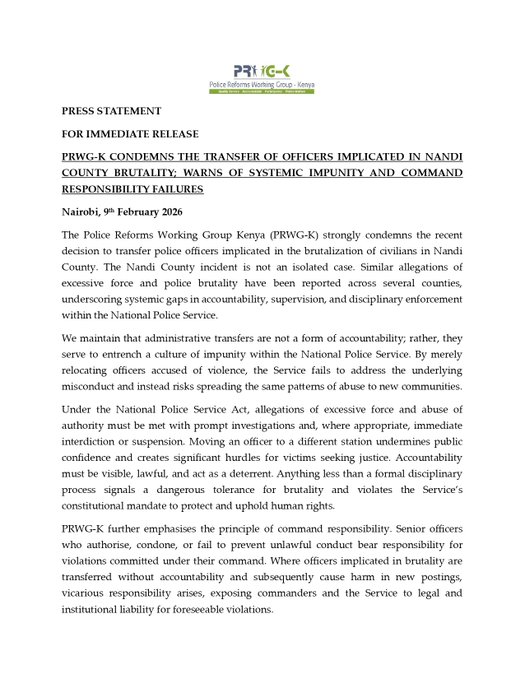

The group further raised concerns about command responsibility, warning that senior officers who authorise, condone, or fail to prevent unlawful conduct may bear liability for violations committed under their command.
“Where officers implicated in brutality are transferred and later cause harm in new postings, vicarious responsibility arises. This exposes commanders and the Service to legal and institutional liability for foreseeable violations,” PRWG-K warned.
The statement called on the Independent Policing Oversight Authority (IPOA) to conduct independent investigations into the Nandi County incidents, provide regular public updates, and recommend formal disciplinary proceedings where evidence supports service offences.
PRWG-K also criticised recent public remarks attributed to Coast Regional Police Commander Ali Nuno, suggesting “shoot-to-kill” directives. While acknowledging the challenges faced by security agencies in responding to violent crime, the group said the use of force must strictly comply with the law.
It cited Section 1, Part A of the Sixth Schedule to the National Police Service Act, which sets out rules on the use of force and firearms, anchored on legality, necessity, proportionality, accountability, and last resort.
“Any directives or conduct outside this framework are unlawful and endanger lives,” the group said.

The National Police Service has previously defended transfers as an administrative tool, arguing that they help maintain operational effectiveness. However, human rights groups have consistently argued that such measures fail to address misconduct and weaken accountability mechanisms.
The debate comes amid heightened scrutiny of policing practices, with oversight bodies such as IPOA and the Kenya National Commission on Human Rights repeatedly raising concerns over excessive force, particularly during security operations and crowd control.
PRWG-K said sustainable public safety cannot be achieved through unlawful force or administrative cover-ups.
“Meaningful police reform requires independent oversight, firm disciplinary action, and unwavering adherence to constitutional and legal standards,” the statement said.



