




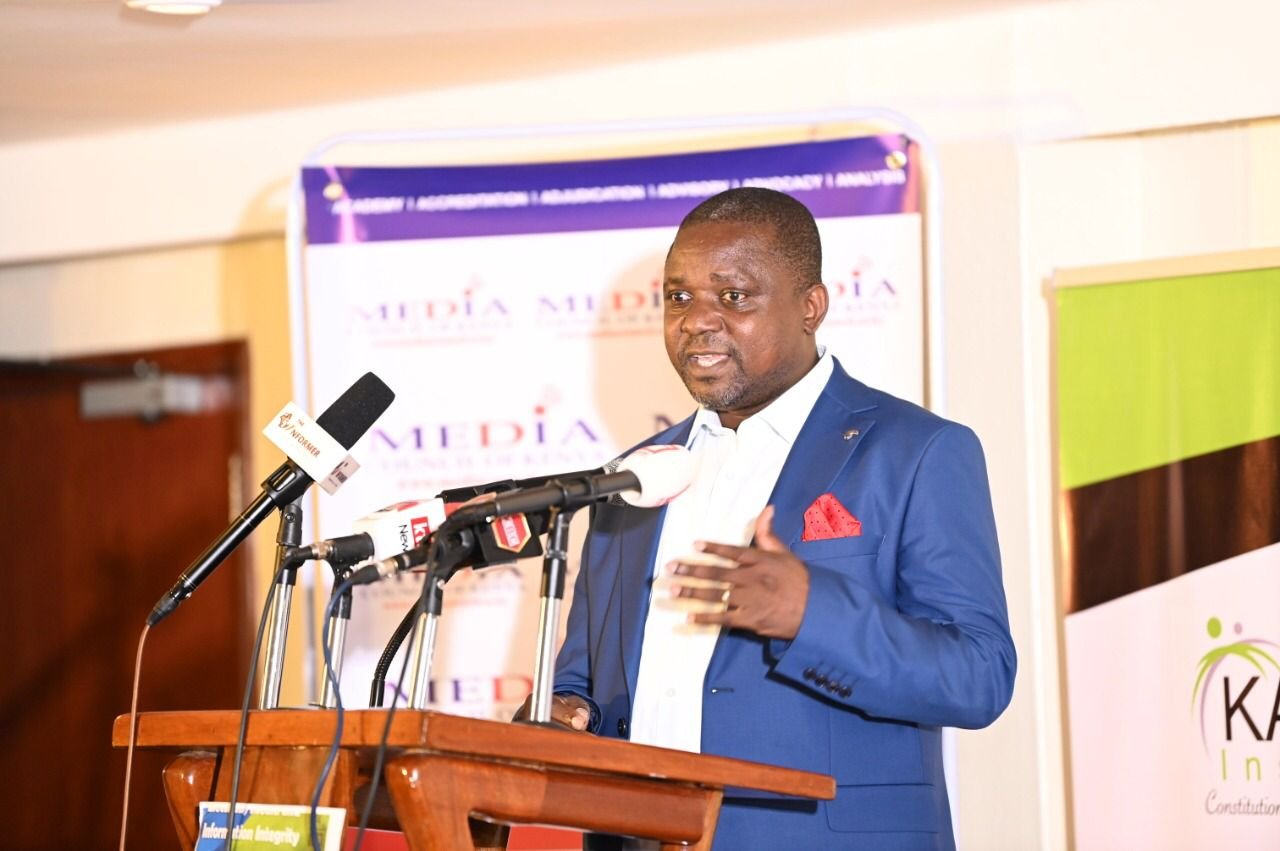
By Victor Bwire,
The physical attacks on journalists and the confiscation of their working equipment during the Ol Kalou by-election are deeply concerning. The messenger is under attack.
It is time individuals took personal responsibility for these assaults against journalists.
Some people wanted the process conducted in the dark, and the fact that they even ordered journalists to delete their footage shows these were targeted attacks.
The perpetrators acted deliberately, determined to ensure citizens were not informed about the process.
It was planned. Cameras, phones and recorders are the known and accepted tools of trade for journalists.
They document and preserve content that the media uses to mirror society, reporters use them to brief their editors, and media houses rely on them as evidence in courts.
To ensure professional and responsible election reporting, the Media Council of Kenya and the IEBC have developed elaborate ethical guidelines for the media and conduct training for journalists before every election.
In addition, the IEBC Act, the Political Parties Act, the NCIC, and individual media houses have guidelines and regulations governing media coverage during elections, providing adequate mechanisms for the media.
Why hooded goons and security officers continue to target journalists during elections remains troubling for a country that aspires to transparent and credible elections.
Attacks and violence against journalists violate the Constitution of Kenya, which guarantees the protection of all citizens and freedom of expression.
Several constitutional provisions reinforce this. Article 26(1) states: “Every person has the right to life.” Sub-section (3) further provides that “a person shall not be deprived of life intentionally, except to the extent authorized by the Constitution or other written law,” while Article 28 guarantees the inherent right to human dignity and to have that dignity respected and protected.
Article 29 specifically protects the freedom and security of the person, making it clear that no one should be deprived of liberty arbitrarily or without just cause.
It also prohibits detention without trial, violence from either public or private sources, torture in any form, physical or psychological, and cruel, inhuman or degrading treatment or punishment.
Every Kenyan and every person in Kenya enjoys these protections without exception, including journalists.
Articles 31 and 32 further safeguard the right to privacy and freedom of conscience, religion, belief and opinion.
The Constitution also states that “the State shall not—(a) exercise control over or interfere with any person engaged in broadcasting, the production or circulation of any publication or the dissemination of information by any medium; (b) penalize any person for any opinion or view or the content of any broadcast, publication or dissemination.”
Kenya is also a signatory to the Sustainable Development Goals, including SDG 16.10, which protects “public access to information and fundamental freedoms in accordance with national legislation and international agreements,” and SDG 16.10.1, which requires member states and other stakeholders to monitor and report the “number of verified cases of killing, kidnapping, enforced disappearance, arbitrary detention and torture of journalists, associated media personnel, trade unionists and human rights advocates in the previous 12 months.”
In addition, these attacks on journalists violate international treaties to which Kenya is a party, including General Comment No. 34 on Article 19 of the International Covenant on Civil and Political Rights. In 1997, UNESCO Member States adopted Resolution 29 on the “Condemnation of Violence against Journalists.”
The resolution responded to growing concern over the killing of journalists in many countries and the spread of impunity, the persistent failure of lawful authorities to bring perpetrators to justice.
UN Security Council Resolution 1738 (2006) similarly condemns attacks against journalists in conflict situations.
Through the Arusha, Addis and Nairobi Declarations on Ending Impunity against Journalists, both state and non-state actors committed, among other actions, to strengthen national mechanisms for the safety of journalists as multi-stakeholder platforms for addressing journalists’ safety and combating impunity for crimes against them; and to establish and support robust monitoring, documentation and reporting systems capable of generating reports for different accountability mechanisms.
Professional reporting gaps that could expose journalists to danger during elections include, but are not limited to, situations where voters and citizens perceive bias or partiality towards candidates by media houses or journalists; repeated and open misinformation, including the publication of unscientific and biased candidate popularity ratings; accusations by candidates blaming journalists for poor electoral performance or favouring opponents; professional reputation risks, including corruption; and legal risks—both criminal and civil—such as offering for sale any ballot paper, purchasing or attempting to purchase a ballot paper, falsely publishing the withdrawal of a candidate, interfering with a voter casting a secret ballot or revealing how a voter marked a ballot, communicating with a voter after the receipt of a ballot paper, wearing apparel within voting precincts indicating support for a candidate, party or contestant, or displaying posters and placards supporting candidates.
Planning for the 2027 General Election must place journalists’ safety at the centre of election preparedness.
This should include comprehensive safety and protection training, rapid response mechanisms for journalists in distress, a legal defence fund to enable journalists to pursue perpetrators of attacks, insurance for media equipment, written commitments by political parties guaranteeing journalists’ safety while covering their events, designated focal points for journalists’ safety within the National Police Service, and permanent coordination structures. Media houses should also establish dedicated election desks, promote professional and responsible reporting, encourage joint media productions and candidate debates, and provide safe working spaces for journalists.
These priorities are no longer optional, they are essential to safeguarding press freedom and the integrity of Kenya’s elections.
The Writer, Victor Bwire, is Director of Media Training and Development at the Media Council of Kenya.