




Sixteen years after Kenya promulgated the Constitution of 2010, there is an uncomfortable contradiction at the heart of Katiba Day.
The country has one of Africa’s most ambitious constitutional texts.
It promises a government restrained by law, an independent Judiciary, devolved power, an expansive Bill of Rights, independent commissions and public officers who exercise authority as a trust.
Yet the political culture the Constitution was designed to transform remains remarkably resilient.
That is the uncomfortable question President William Ruto’s Katiba Day speech raises, even if he did not put it quite that way: Has Kenya transformed the exercise of power, or has it simply changed the rules on paper while political power continues to behave much as it did before?
The answer, after 16 years, is complicated.
From Kibaki’s inauguration to Katiba@16
To understand the significance of the 2010 Constitution, one has to go back to December 2002.
Mwai Kibaki’s election ended 24 years of KANU rule and generated enormous expectations for political reform.
His administration came to power promising constitutional change, but the process quickly became entangled in the familiar politics of personalities, coalitions and competing interests.
The 2005 constitutional draft was rejected in a referendum, demonstrating that constitutional reform could not simply be dictated from State House.
Then came the 2007 election crisis.
The disputed presidential election and the violence that followed exposed the dangers of an excessively powerful presidency, weak institutions and a political system in which losing power could appear existential.
More than 1,000 people were killed and hundreds of thousands displaced.
The post-election crisis ultimately created the political conditions for the constitutional settlement that Kenyans approved overwhelmingly in 2010.
And there lies the first irony.
The Constitution of 2010 was not born because Kenya’s political class suddenly discovered constitutional virtue.
It was born because the consequences of unchecked political power had become impossible to ignore.
Kibaki therefore occupies a unique place in this story.
He inherited the old constitutional order and presided over the political process that eventually produced the new one.
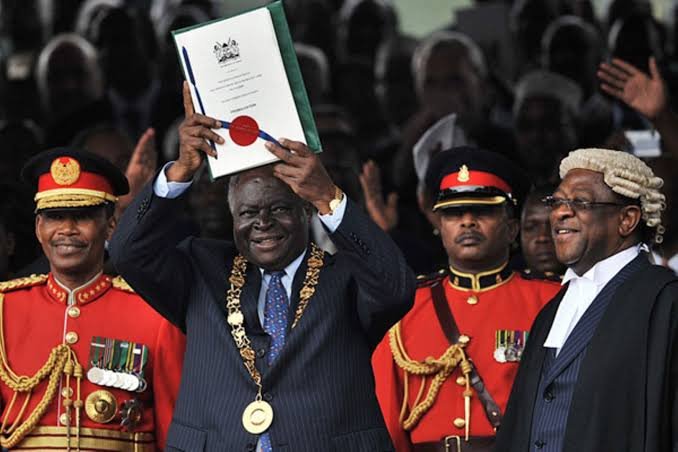
On August 27, 2010, it was Kibaki who stood at Uhuru Park and promulgated the Constitution that fundamentally redistributed power away from the centre.
But the transformation was never going to be achieved by a document alone.
The Constitution’s biggest success: it changed the architecture of the State
There is a danger, particularly on Katiba Day, of focusing exclusively on failures.
That would be unfair.
The 2010 Constitution has fundamentally changed Kenya.
Devolution transferred significant political and financial power to 47 counties.
The Judiciary gained greater institutional independence.
The Bill of Rights became considerably stronger. Parliament became bicameral.
Constitutional commissions gained greater prominence. Presidential power was subjected to stronger checks.
Most importantly, ordinary Kenyans acquired constitutional language with which to challenge the State.
A citizen no longer has to accept that government action is automatically lawful simply because it originates from State House.
The courts have demonstrated that they can restrain the Executive.
That is not a small achievement.
Indeed, the Judiciary’s strengthened role became particularly visible when the Supreme Court overturned the 2017 presidential election and ordered a fresh poll. It demonstrated that the presidency, however powerful, was no longer constitutionally untouchable.
The Supreme Court’s later decision against the Building Bridges Initiative was another demonstration of institutional checks and balances.
In 2022, the court stopped the proposed constitutional amendments, holding that the process initiated by President Uhuru Kenyatta could not proceed in the manner pursued.
That is precisely what constitutionalism is supposed to do.
But there is another side.
The presidency survived the Constitution
The great unfinished business of the 2010 Constitution may be the Kenyan presidency itself.
The Constitution attempted to restrain the imperial presidency. But Kenyan politics remains heavily organised around the person occupying State House.
Elections continue to be presidential contests first and policy contests second.
Political parties remain heavily personality-driven.
Government appointments remain politically consequential.
Parliament frequently operates within the orbit of the Executive.
And the State’s enormous administrative and security machinery continues to give the presidency immense practical power.
In other words, Kenya dismantled much of the legal architecture of the imperial presidency without completely dismantling the political culture that sustains it.
That explains why every administration eventually finds itself confronting the same institutional question: how much power should the Executive have, and what happens when the institutions designed to restrain it become inconvenient?
Ruto’s Katiba Day speech is therefore both powerful and uncomfortable
President Ruto’s speech on Thursday contained some of the strongest constitutional language a Kenyan president could use.
He said judicial independence is “non-negotiable”.
He said that where government acts unlawfully, it must obey the courts and correct its course.
He acknowledged allegations of unlawful arrests, enforced disappearances and excessive use of lethal force during protests.
He also said peaceful protest is a constitutional right and that credible allegations of human-rights violations must be independently, thoroughly and transparently investigated.
Those are important statements.
But they also create a standard against which the administration must be judged.
Because constitutionalism is not measured by what a president says about the Constitution on August 27.
It is measured by what government does on August 28.
And that is where the celebration becomes uncomfortable.
Court orders are not suggestions
One of the clearest tests of constitutional government is whether the Executive obeys judicial decisions it dislikes.
Kenya has had several episodes in which government officials have been accused of disregarding or delaying compliance with court orders.
The problem became impossible to ignore in 2024 when then-acting Inspector-General of Police Gilbert Masengeli was sentenced to six months in prison for contempt after repeatedly failing to appear in court over the disappearance of three men.
The issue has not disappeared.
In June 2026, Health Cabinet Secretary Aden Duale was found in contempt of court over the construction of a US-backed Ebola facility despite an order suspending the project.
Whether one agrees with the government’s policy or not is beside the point.
A constitutional democracy cannot operate on the principle that government obeys courts only when it agrees with them.
Article 10 places the rule of law among Kenya’s national values and principles of governance. Compliance with lawful judicial decisions is therefore not a courtesy extended by the Executive to the Judiciary.
It is part of constitutional government.
The protest question is even more serious
If there is one area where the gap between constitutional promise and lived experience has become particularly stark, it is the right to protest.
Article 37 gives every person the right, peaceably and unarmed, to assemble, demonstrate, picket and present petitions to public authorities.
Ruto acknowledged this in his speech.
He also recognised that young Kenyans who demonstrated in 2024 were exercising legitimate constitutional freedoms and demanding accountability.
But Kenya’s protest history since 2024 has also been marked by allegations of excessive force, arbitrary arrests, abductions and killings.
Human-rights organisations have repeatedly raised concerns about the treatment of protesters.
In 2025, the Kenya Human Rights Commission accused the government of a pattern of constitutional violations and described the declaration of Katiba Day itself as potentially an attempt to sanitise the government’s record.
More recently, the Katiba Institute said police roadblocks, arrests and disruption of peaceful Gen Z memorial protests in June 2026 violated constitutional rights, pointing specifically to an earlier court judgment requiring police to facilitate peaceful assemblies rather than impose blanket restrictions.
This creates perhaps the sharpest contradiction of Katiba@16.
The government says the Constitution protects peaceful protest. Citizens say they have been punished for exercising that right.
Both propositions cannot comfortably coexist.
The verdict is neither complete success nor complete failure.
Kenya has built considerably stronger constitutional institutions than it had before 2010.
But the country’s political culture has not evolved at the same speed.
The Constitution has created checks. The political class keeps testing them.
The courts have asserted independence. The Executive keeps asking how much room it should have.
Citizens have acquired rights. The State keeps being reminded that those rights are real.
That tension is not necessarily a sign that the Constitution is failing.
It may be evidence that it is alive.
But a Constitution cannot defend itself indefinitely.
Ultimately, it depends on the people who occupy State institutions choosing to respect it and on citizens being willing to hold them accountable when they do not.
Sixteen years after Kibaki promulgated it, that remains Kenya’s unfinished constitutional project.