




ATHENS, Greece — Two crew members were killed after two firefighting helicopters collided mid-air while battling a major wildfire near Athens, Greek authorities said, as the country continues to battle multiple blazes amid extreme summer conditions.
The victims were identified as a Danish pilot and a Greek Fire Service liaison officer. A British pilot and another Greek Fire Service liaison officer aboard the second helicopter survived the crash.
According to the Greek Fire Service, the two leased Bell helicopters were taking part in aerial firefighting operations over the Attica-Boeotia border when they collided during efforts to contain a large wildfire burning in the Psatha area, about 65 kilometres west of Athens.
Video circulating after the incident showed one helicopter striking the rotor blades of the other before one aircraft burst into flames. Both helicopters then plunged into a nearby ravine.
Authorities said the crew members from one helicopter were rescued alive, while the occupants of the second aircraft were recovered unconscious and later pronounced dead.
The Fire Department said the collision occurred during an active forest firefighting mission as emergency responders worked to contain fast-moving flames threatening several communities.
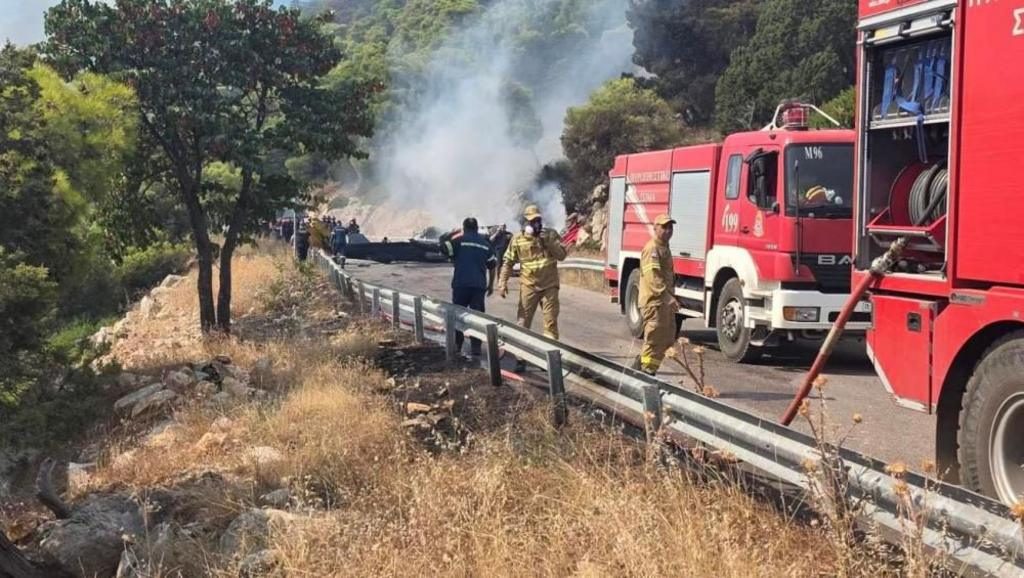
The fatal accident comes as Greece battles multiple wildfires that have forced mass evacuations across parts of the country.
Media reports described an intense firefighting operation stretching across Porto Germeno, Psatha, Fokida, Megara and Kefalonia, where more than 500 firefighters have spent the past three days trying to bring the fires under control.
The wildfires in Greece are part of a broader wave of blazes affecting southern Europe following successive heatwaves.
Earlier this week, France and Spain also battled major wildfires, including large outbreaks near Madrid and Bordeaux. Authorities said the fires have since been contained, allowing approximately 300,000 evacuated residents to begin returning to their homes.
Scientists have warned that while most wildfires are caused by human activity—either accidentally or deliberately—climate change is increasing the frequency and intensity of conditions that allow fires to spread rapidly.
A mild, wet winter encouraged vegetation growth across parts of southern Europe before prolonged periods of high temperatures dried the landscape, creating abundant fuel for wildfires.
Authorities in Greece continue to monitor active fire fronts as emergency crews work to contain the remaining blazes and prevent further loss of life and property.


