




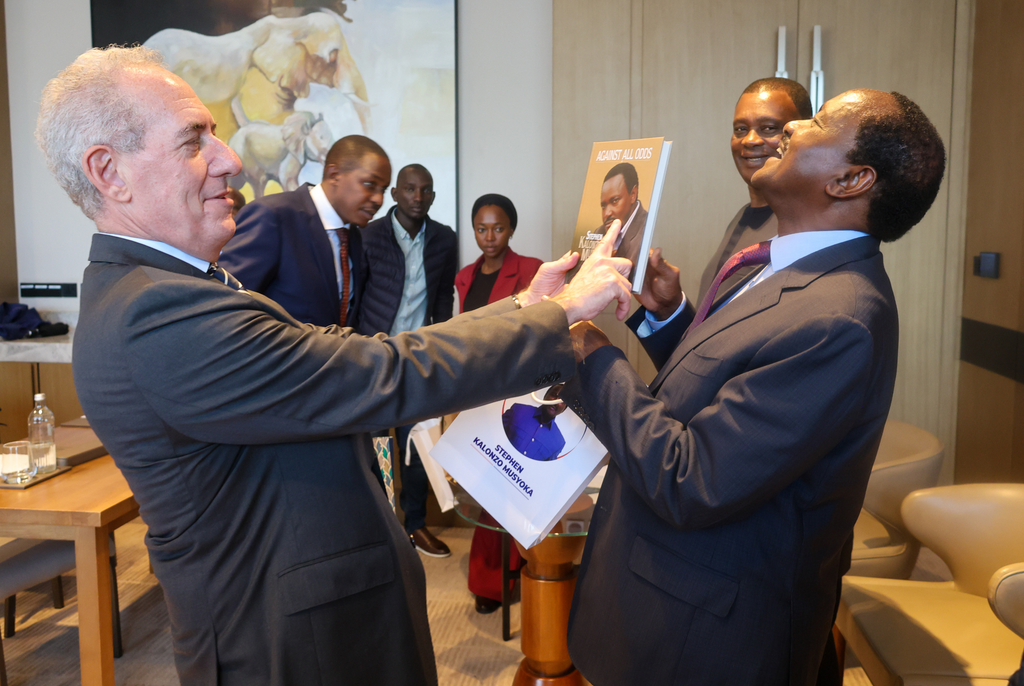
Wiper Patriotic Front leader Kalonzo Musyoka has led a delegation of opposition politicians in presenting concerns over Kenya’s preparedness for the 2027 General Election to the United States-based Council on Foreign Relations (CFR), warning that the independence of the electoral commission will be critical to the credibility of the polls.
NAIROBI, Kenya – The delegation met CFR President Michael Froman on Monday, November 16, 2026, with the opposition leaders raising concerns about the Independent Electoral and Boundaries Commission (IEBC), alleged political violence, corruption and what they described as weakening democratic institutions.
Kalonzo was accompanied by People’s Liberation Party leader Martha Karua, Democratic Party leader Justin Muturi, Democratic Action Party-Kenya (DAP-K) leader Eugene Wamalwa and National Assembly Deputy Minority Leader Robert Mbui.
In a statement following the meeting, the Wiper leader argued that Kenya could not hold credible elections if the electoral commission was not independent and impartial.
“There can be no free and fair election when the Independent Electoral and Boundaries Commission is not independent,” Kalonzo stated.
He accused President William Ruto’s administration of using public resources and civil servants to advance political interests ahead of the August 10, 2027 General Election.
The opposition delegation also alleged that bribery and other forms of electoral interference were taking place, warning that such practices could undermine the credibility of the next polls.
The claims were presented by the opposition leaders during their engagement with the foreign policy organisation and were not independent findings by the Council on Foreign Relations.
Kalonzo raises alarm over attacks on opposition gatherings
The opposition leaders also told the CFR that violence and intimidation targeting political gatherings could threaten the environment in which parties campaign ahead of the election.
Kalonzo claimed that opposition meetings had been disrupted by groups of attackers, with supporters and political leaders allegedly stoned, tear-gassed and injured.
He further accused security officers of using excessive force, including firing live ammunition at opposition supporters during political activities.
“A regime that turns violence on citizens exercising their democratic rights has no business talking about peaceful elections,” he said.
The allegations come against the backdrop of documented attacks on political and civil society gatherings.
In September 2026, Human Rights Watch reported that organised gangs had attacked opposition and civil society events in different parts of Kenya, with at least six people reportedly killed and dozens injured.
The organisation highlighted the June 12 attack on a civil society meeting at All Saints Cathedral in Nairobi, violence during the Ol Kalou by-election and the July attack on a church gathering attended by opposition politicians in Kisumu.
It also documented the August 16 attack on a convoy transporting Linda Mwananchi supporters and politicians to a planned rally in Homa Bay, where at least three people were killed and journalists assaulted.
Human Rights Watch called on Kenyan authorities to investigate the attacks and ensure that citizens could exercise their political rights without fear of violence.
Opposition accuses Ruto of weakening Parliament
Beyond electoral preparedness and political violence, the delegation raised concerns about the separation of powers and the functioning of Parliament.
Kalonzo accused the Executive of exerting excessive influence over the legislature, arguing that Parliament was increasingly failing to exercise its constitutional oversight responsibilities.
The leaders also criticised the government’s foreign policy, particularly its handling of the conflict in Sudan.
Kalonzo claimed that President Ruto’s perceived interests in Sudan’s Rapid Support Forces (RSF) had compromised Kenya’s neutrality and diplomatic standing in the region.
Kenya’s engagement with Sudanese political and military actors has attracted criticism amid the conflict between the Sudanese Armed Forces and the RSF.
The opposition also accused the government of presiding over rising corruption and failing to respect constitutional accountability mechanisms.
Kalonzo said the delegation had emphasised that Kenyans would pursue political change through the ballot in 2027.
IEBC faces financial and operational challenges
The meeting comes as the IEBC continues preparations for the next General Election amid questions about funding, institutional capacity and public confidence.
The commission has identified financing as one of its major challenges, warning that insufficient resources could affect voter registration, civic education, election technology, logistics and procurement of election materials.
In a presentation to Parliament on January 27, 2026, IEBC Chairperson Erastus Ethekon outlined a total election resource requirement of approximately Sh63.95 billion.
The National Treasury had allocated approximately Sh41 billion, leaving a projected funding gap of Sh22.94 billion across the three financial years covered by the commission’s budget.
The commission warned that the shortfall could constrain critical preparations, including voter education, staff training, stakeholder engagement, election security and procurement.
It also identified outstanding legal bills exceeding Sh3.8 billion and limited in-house legal capacity as additional challenges.
The commission has separately highlighted the need for electoral law reforms, warning that delays in enacting changes could complicate preparations for the 2027 polls.
The IEBC has also been working to rebuild public confidence following its reconstitution in July 2025.
The opposition has repeatedly questioned the commission’s independence and demanded transparency in its preparations, arguing that public trust in the electoral body will be central to acceptance of the election outcome.
Kalonzo prepares for seven-day US tour
The engagement with the Council on Foreign Relations comes ahead of a planned seven-day visit to the United States by Kalonzo and a nine-member opposition delegation.
The tour is scheduled to run from November 18 to 24, 2026, with planned engagements involving American lawmakers, academic institutions, investment stakeholders and Kenyans living in the diaspora.
The programme includes meetings at Capitol Hill in Washington, DC, and an engagement at the Massachusetts Institute of Technology (MIT) in Boston.
The delegation is also expected to hold town hall meetings with Kenyans in Germantown, Baltimore, Minneapolis and Cleveland.
The visit forms part of the opposition’s wider efforts to present its political agenda and concerns about Kenya’s democratic institutions to international audiences ahead of the 2027 General Election.


