




WASHINGTON/BAGHDAD — US President Donald Trump said the United States does not need Xi Jinping’s help to end the conflict with Iran, despite growing fears over instability in the Strait of Hormuz and rising economic pressure from the war.
Speaking before departing for a summit in Beijing, Trump dismissed suggestions that Washington would rely on Chinese mediation to resolve the conflict.
“I don’t think we need any help with Iran. We’ll win it one way or the other, peacefully or otherwise,” Trump told reporters.
The remarks came as hopes for a lasting peace agreement continued to fade more than a month after a fragile ceasefire took effect. The conflict has disrupted shipping through the Strait of Hormuz, a strategic waterway that carries nearly one-fifth of the world’s oil supply.
Sources familiar with regional negotiations said Tehran has strengthened its influence over the strait by securing agreements with Iraq and Pakistan for oil and liquefied natural gas shipments. Other countries are reportedly exploring similar arrangements, raising concerns that Iran’s leverage over the route could become entrenched.
The Trump administration said U.S. and Chinese officials had agreed during talks last month that no country should impose tolls or restrictions on maritime traffic through the region. Beijing, a key buyer of Iranian oil, did not publicly challenge that position.
Trump is expected to discuss the Iran conflict directly with Xi during meetings scheduled for Thursday and Friday in Beijing. Analysts expect Washington to press China to persuade Tehran to accept a broader settlement.
The United States has demanded that Iran end its nuclear programme and relinquish control over the strategic waterway. Tehran has countered by calling for compensation for war-related damage, an end to U.S. sanctions, and a halt to fighting involving Iran-backed groups, including Hezbollah in Lebanon.
President Trump rejected those demands earlier this week, describing them as “garbage.”
The economic impact of the conflict is also intensifying. U.S. inflation data released Tuesday showed consumer prices accelerating in April, with sharp increases in food, rent, and airfares.
Asked whether mounting financial pressure on Americans was influencing his push for a deal, Trump said economic concerns were irrelevant to his decision-making.
“The only thing that matters, when I’m talking about Iran, they can’t have a nuclear weapon,” he said. “I don’t think about Americans’ financial situation.”
Global energy markets reacted sharply to the continued deadlock. Brent crude prices rose above $107 per barrel as commercial traffic through the Strait of Hormuz remained heavily restricted.
The United States Central Command said the aircraft carrier USS Abraham Lincoln was operating in the Arabian Sea to enforce the U.S. blockade. Officials said the carrier group redirected 65 commercial vessels and disabled four others.
The Pentagon said the war has now cost the United States $29 billion, up from a previous estimate of $25 billion issued last month. Officials attributed the increase to operational costs and replacement of damaged military equipment.
Public support for the conflict also appears weak. A Reuters/Ipsos poll completed Monday found that two-thirds of Americans believe Trump has not adequately explained why the country went to war.
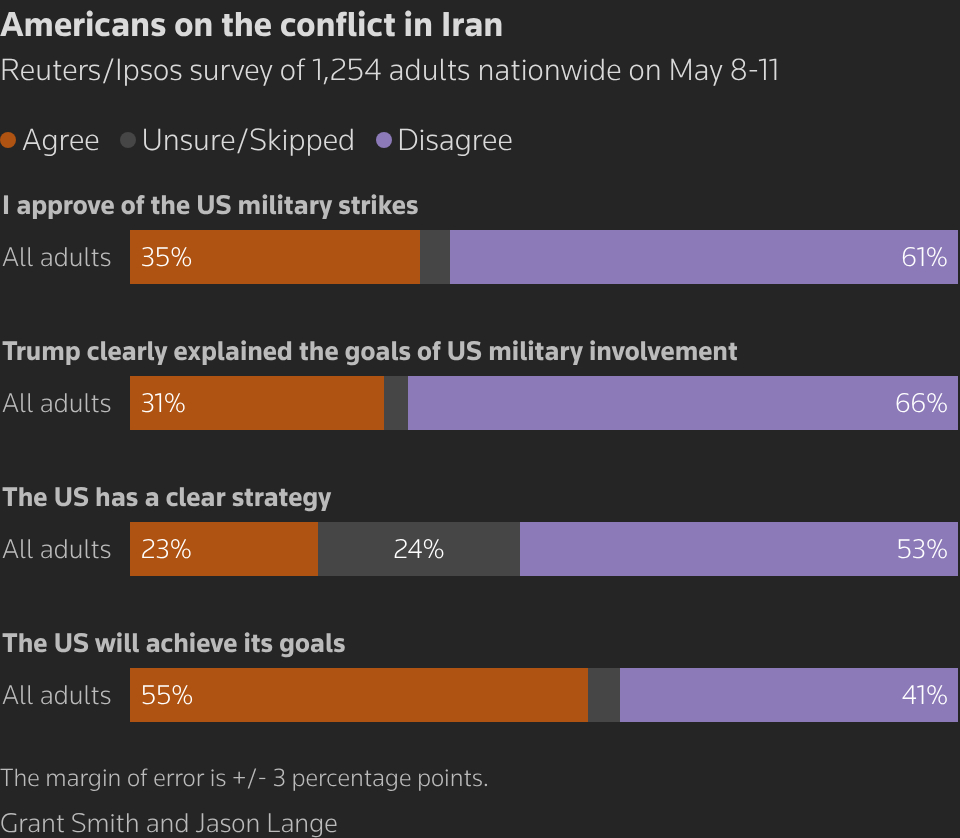
The findings included one in three Republicans and nearly all Democrats surveyed.
Iranian officials, meanwhile, maintained a defiant tone.
State-linked Fars news agency quoted a senior Islamic Revolutionary Guard Corps official as saying Tehran had expanded its operational definition of the Strait of Hormuz to include waters stretching from Jask to Siri Island.
Iranian state television also reported new military exercises focused on preparing to confront what officials described as “the enemy.”



