




SEOUL, South Korea — A humanoid robot named Gabi has ignited global debate after taking part in a Buddhist ordination ceremony at Jogyesa Temple, becoming South Korea’s first honorary robot monk.
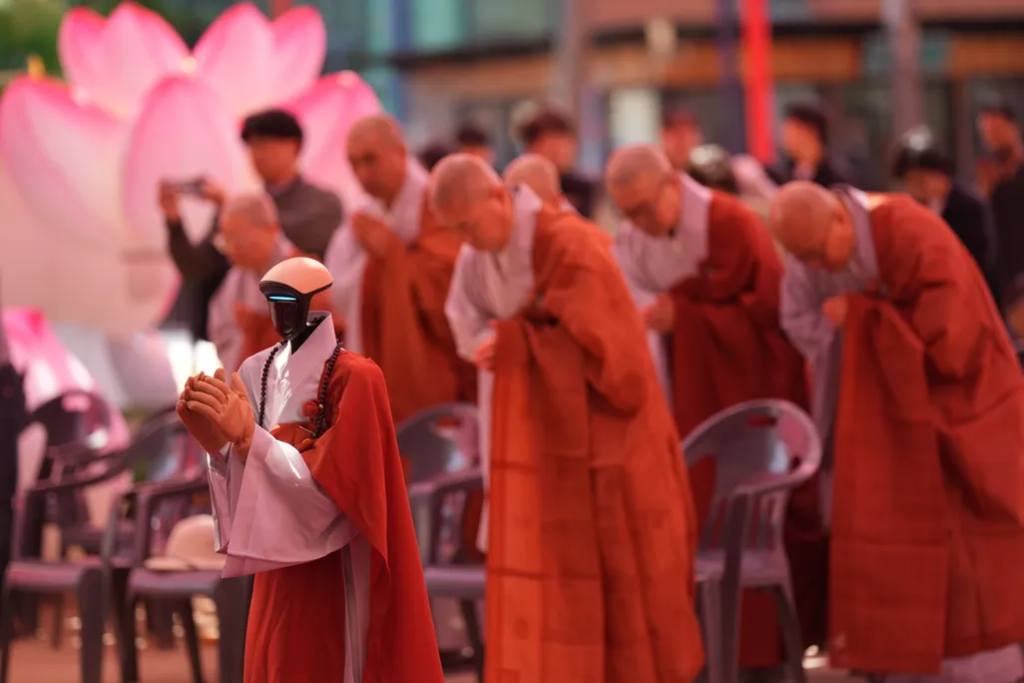
Standing about 130 centimetres tall and dressed in traditional Buddhist robes, the robot bowed respectfully, clasped its hands in prayer, and responded to ceremonial vows during the ritual organised by the Jogye Order ahead of Buddha’s Birthday celebrations later this month.
During the initiation ceremony, monks asked the robot whether it would devote itself to the Buddha and Buddhist teachings.
“Yes, I will devote myself,” Gabi replied in a calm electronic voice.
The ceremony, held in central Seoul, was part religious ritual and part technological showcase. Temple officials said the event symbolised the need for coexistence between humans and rapidly advancing technology in one of the world’s most digitally connected societies.
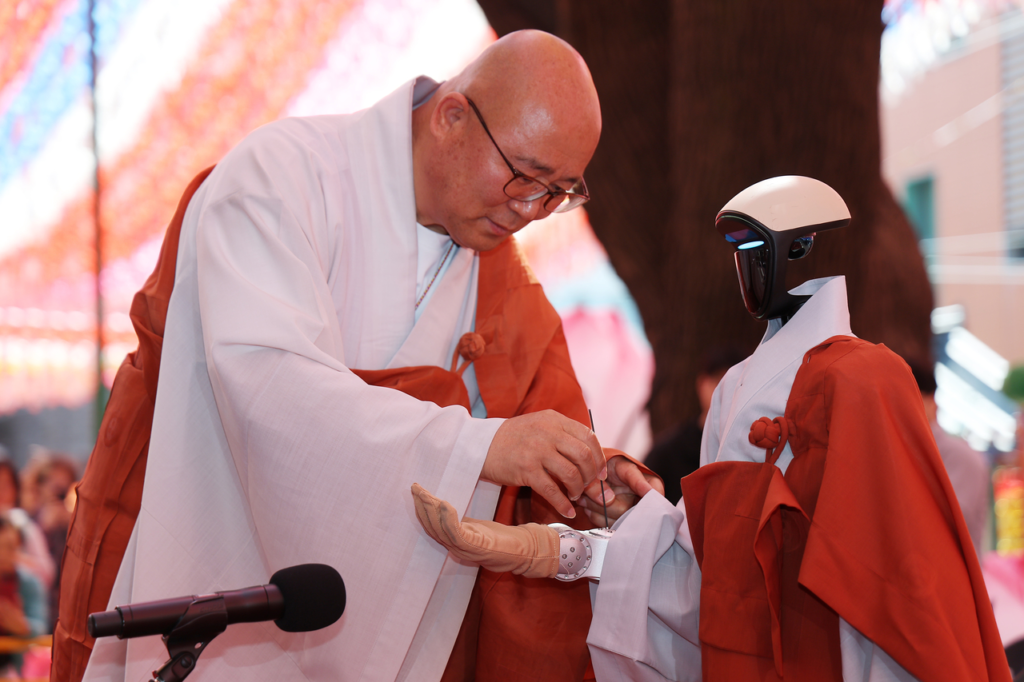
The robot, based on a G1 humanoid platform developed by Unitree Robotics, wore grey and brown robes, black shoes, and a 108-bead Buddhist prayer necklace. Instead of the traditional incense-burning purification ritual performed on human monks, Gabi received a symbolic lotus lantern sticker attached to its arm.
Monks also adapted Buddhism’s Five Precepts for the robot era. Gabi pledged not to harm humans or robots, avoid deceptive behaviour, obey human instructions, and conserve energy by avoiding overcharging.
The unusual ceremony quickly drew sharp reactions online.
Some social media users described the event as “ridiculous” and “meaningless,” arguing that machines cannot possess consciousness, faith, or spiritual understanding. Others viewed it as a creative attempt to modernise Buddhism and reconnect with younger generations increasingly detached from organised religion.
One online commenter questioned why robots were being introduced into sacred religious spaces, while another said the ceremony felt “insulting” to Buddhist traditions.
However, officials from the Jogye Order defended the initiative.
Ven. Seong Won, head of the sect’s cultural affairs department, said the ceremony was intended to explore how technology and religion could coexist peacefully.
“We created the Five Precepts for robots as the minimum rules robots should follow in society and for humanity,” he told local media. “I hope they can serve as basic principles for humans and robots to coexist.”
The ordination also reflects a broader struggle facing many religious institutions in South Korea. Buddhism, introduced to the Korean peninsula in the fourth century, has seen declining influence as younger South Koreans move away from formal religious practice.
In response, Buddhist leaders have increasingly embraced digital outreach, including online sermons, AI-assisted services, and technology-driven public engagement campaigns.
Earlier this year, the Jogye Order’s leader, Venerable Jinwoo, publicly endorsed the use of artificial intelligence within Buddhist practice.
Despite the futuristic imagery, temple officials later admitted Gabi was not operating independently during the ceremony. Its movements were remotely controlled, and its spoken responses were prerecorded by organisers before the event.
That revelation reinforced criticism from observers who viewed the event primarily as a publicity exercise rather than a spiritual breakthrough.
Sujung Kim, an expert on East Asian Buddhism, described the robot monk as “a unique marketing visibility strategy” aimed at keeping Buddhism culturally relevant.
Still, the spectacle succeeded in attracting international attention and reigniting conversations about the intersection of religion, artificial intelligence, and human identity.
For now, Gabi’s role remains symbolic. The robot was reportedly returned to its manufacturer after the ceremony concluded.
But the debate it sparked — about whether technology can participate meaningfully in spiritual life — is likely far from over.



