




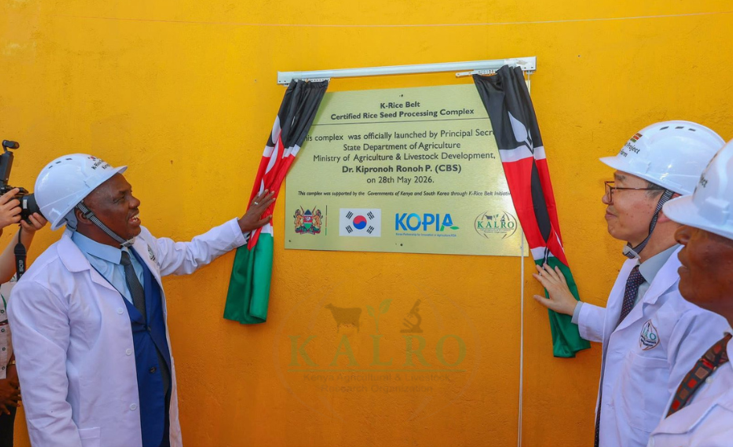
KIRINYAGA, Kenya — The Kenya Agricultural and Livestock Research Organization has launched the K-Rice Belt Certified Rice Seed Processing Complex at Kirogo Farm in a move aimed at increasing certified rice seed production and strengthening Kenya’s food security.
The facility was launched in partnership with KOPIA Kenya Center under the K-RICE Initiative during an event attended by government officials, researchers, county leaders, and farmers.
The launch was presided over by Kiprono Rono and Kang Hyung-shik alongside key stakeholders from KALRO and the farming community.
Seed Production Capacity to Increase Sharply
According to Dr. Rono, the new facility will significantly expand Kenya’s certified rice seed processing capacity from 40 tonnes per day to 700 metric tonnes.
He said the project is expected to improve farmers’ access to quality seeds, reduce dependence on imported rice, and support the country’s broader food security agenda.
“Farmers should adopt climate-resilient rice varieties such as Komboka and embrace modern agricultural technologies to enhance productivity and livelihoods,” Rono said.
Kenya has long struggled with low domestic rice production, forcing the country to rely heavily on imports to meet growing consumer demand.
Farmers Expected to Benefit From Lower Seed Costs
Thuo Mathenge said the facility would help reduce the cost of certified rice seed, making it more affordable for farmers across rice-growing regions.
He noted that cheaper access to quality seed would reduce production costs while increasing productivity and farmer incomes.
“The initiative will directly benefit farmers by reducing input expenses, increasing productivity, and strengthening food security,” Mathenge stated.
Agricultural experts have repeatedly identified high seed costs and limited access to certified seed as key barriers affecting rice production in Kenya.
Addressing Seed Shortages in Rice Farming
Patrick Ketiem described the facility as a major breakthrough in addressing one of the biggest constraints in Kenya’s rice value chain.
“The facility is the beginning of solving the biggest constraint in the rice value chain, inadequate access to certified seeds by farmers,” Ketiem said.
He observed that many farmers have historically relied on uncertified seeds, contributing to low yields and continued dependence on rice imports.
The government has increasingly prioritised agricultural modernisation and climate-smart farming under ongoing food security reforms.
Push for Self-Sufficiency in Rice Production
The launch of the processing complex marks a significant step in Kenya’s efforts to achieve greater self-sufficiency in rice production amid rising demand and climate-related challenges affecting agriculture.
Rice consumption in Kenya has grown steadily over the years, but local production has remained insufficient to meet national demand.
The initiative also aligns with Kenya’s broader agricultural transformation agenda focused on food security, value addition, and sustainable farming technologies.

