




NAIROBI, Kenya — Interior Cabinet Secretary Kipchumba Murkomen has unveiled a 10-year plan to restore the degraded Cherangany Hills ecosystem, warning that environmental damage in the region is already costing lives and livelihoods.
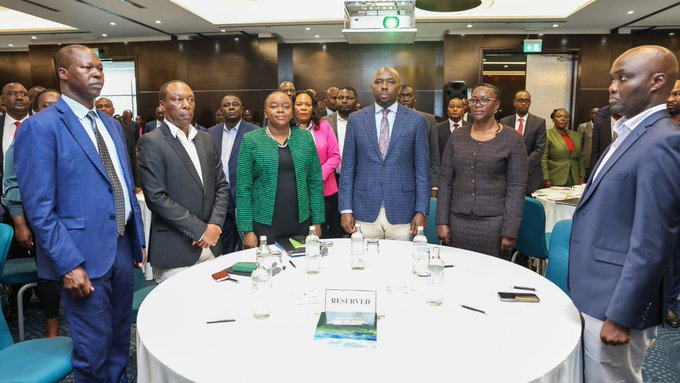
Speaking during a partners’ briefing, Murkomen said the government will roll out the Cherangany Hills Ecosystem Restoration for Livelihood Improvement, Sustainability and Harmony (CHERISH) programme as part of efforts to rehabilitate one of Kenya’s key water towers.
The Cherangany Hills, which span Elgeyo-Marakwet, West Pokot, Trans-Nzoia and Uasin Gishu counties, cover approximately 414,928 hectares and play a critical role in water catchment and biodiversity conservation.
Murkomen said the ecosystem has suffered extensive degradation due to unregulated human activities, leading to landslides, biodiversity loss and disruption of livelihoods.
“Currently, 15pc of the ecosystem is severely degraded, while 67pc is moderately degraded,” he said, adding that over 41,547 hectares of forest cover and 76,757 hectares of grassland have already been lost.
The CHERISH programme aims to restore 62,038 hectares of degraded escarpments and riparian land, protect at least 20 springs, and safeguard the water tower as part of the government’s broader environmental agenda.
Murkomen said the initiative is anchored on President William Ruto’s 15 billion tree-planting programme and will also focus on economic empowerment.
“We seek to create 500,000 green jobs for our youth in bee-keeping, agro-forestry, and eco-tourism,” he said, framing the plan as both an environmental and socio-economic intervention.
The programme is expected to bring together multiple stakeholders, including government agencies, development partners, private sector players, and local communities in what Murkomen described as an “all-of-society” approach.
The official launch is scheduled for May 22, 2026, in Elgeyo-Marakwet County, coinciding with the International Day of Biodiversity. It will be preceded by the inaugural Cherangany Conservation Run on May 21.
Murkomen said the government is seeking sustained support from partners to ensure long-term success, noting that environmental restoration requires coordinated investment and community participation.
Among partners present at the briefing were organisations such as United Nations Development Programme (UNDP), Equity Group Holdings, KCB Group, Intergovernmental Authority on Development (IGAD), and World Wide Fund for Nature Kenya (WWF Kenya), among others.


