




NAIROBI, Kenya — The United States’ acting ambassador to Kenya, Susan Burns, has issued a sharp warning to Kenyan media houses over unethical practices, including undisclosed paid content and “brown envelope” journalism, saying they risk eroding public trust and undermining press freedom.
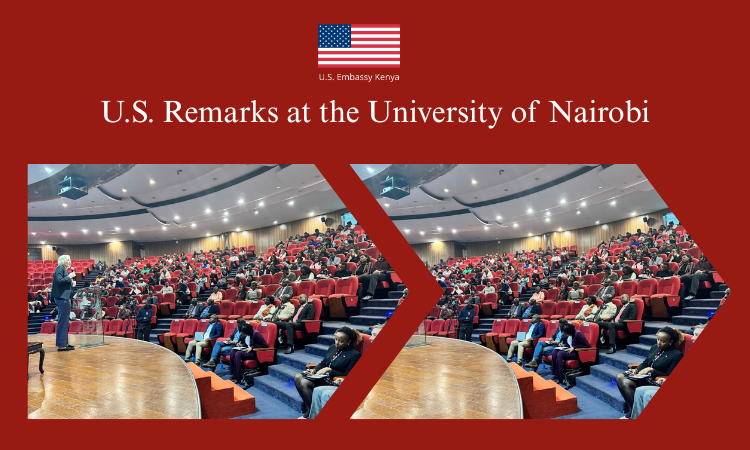
Speaking at the University of Nairobi on April 30, Burns urged journalists and editors to uphold transparency and editorial independence, especially in an era of digital misinformation and artificial intelligence-driven content.
“Offering editorial space to the highest bidder is selling out your freedom,” Burns said, in remarks delivered ahead of World Press Freedom Day marked on May 3.
Her comments come amid growing scrutiny of media sustainability in Kenya, where declining advertising revenues and delayed payments have strained newsroom operations, raising ethical concerns about influence and credibility.
Burns revealed that the U.S. Embassy had been approached by some Kenyan media outlets seeking payment for interviews and opinion placements, a practice she said the mission declined.
“I’m not going to name names, but I assure you we did not pay for coverage,” she said, adding that publishing externally written opinion pieces without disclosure “turns the byline into a mask.”
The envoy emphasised that journalism’s core duty is to reveal truth, not obscure it, warning that failure to disclose financial or political influence amounts to “malign propaganda” that weakens democratic institutions.
“This practice… will eventually destroy your most important resource: trust,” she said.
Burns contrasted Kenya’s media environment with that of the United States, noting that American journalists do not require government licensing and operate independently of state-controlled advertising, which she said is not a significant revenue source.
She also highlighted constitutional protections for press freedom in both countries, referencing Kenya’s Article 34 and the U.S. First Amendment, which guarantee freedom of expression and media independence.
“In both our countries, a free press serves as a guard against tyranny and holds power to account,” she said.
However, she acknowledged that media freedom remains under pressure globally, with journalists facing harassment, threats, and violence, often outside formal legal channels.
Burns called for stronger ethical standards in Kenyan journalism, urging media houses to clearly label sponsored content and disclose any external funding or influence.
“Kenyan citizens have the right to know who is paying for their news—whether it is a local business, a politician, or a foreign government,” she said.
Her remarks also touched on emerging risks posed by deepfakes and AI-generated content, which she said make credibility and verification more critical than ever.
The envoy reiterated the U.S. government’s support for media development in Kenya, including training and exchange programmes, but stressed that such support is openly disclosed and does not influence editorial content.
“We do not pay journalists to write pro-American pieces under their bylines without disclosure, nor do we censor or pre-screen their coverage,” she said.
Burns encouraged Kenyan journalists to embrace scrutiny and diverse viewpoints, noting that democracy thrives when competing ideas are openly debated.
Her address adds to ongoing debates within Kenya’s media sector over sustainability, regulation, and independence, particularly as the country heads toward the 2027 General Election—a period historically associated with heightened political pressure on the press.


