




Nairobi, Kenya- Presidential apirant Boniface Mwangi has strongly criticized the High Court ruling declaring graffiti on matatus illegal, describing the decision as outdated, harmful, and disconnected from Kenya’s vibrant creative culture.
In a fiery statement issued after the ruling, Mwangi argued that graffiti is a respected art form and that banning it on matatus would damage livelihoods, erase an internationally recognized cultural identity, and deepen unemployment in the country.
“Graffiti is high art, and the High Court ruling declaring graffiti on matatus illegal is backward, retrogressive and lacks basic common sense,” Mwangi said.
His comments come after a court decision that sparked widespread debate among Kenyans, especially those who view Nairobi’s colorful matatus as more than public transport vehicles, but symbols of youth culture, creativity, and self-expression.
Mwangi said he has personally worked with graffiti artists for years and has witnessed their talent create opportunities both locally and internationally.
“As a creative who has mentored graffiti artists since 2010, I have helped a number of them secure opportunities to travel the world and showcase their work,” he stated.
According to him, Kenyan graffiti artists rank among the finest on the continent and deserve recognition rather than punishment.
“Kenyan graffiti artists are among the best in our continent,” he added.
Mwangi pointed to several prestigious institutions where graffiti and mural artists have already been commissioned to beautify spaces, arguing that the same art being celebrated in offices and public buildings should not suddenly be condemned on matatus.
He noted that artists have created murals at Jomo Kenyatta International Airport, the Central Bank of Kenya, Safaricom offices in Nairobi, and many other establishments.
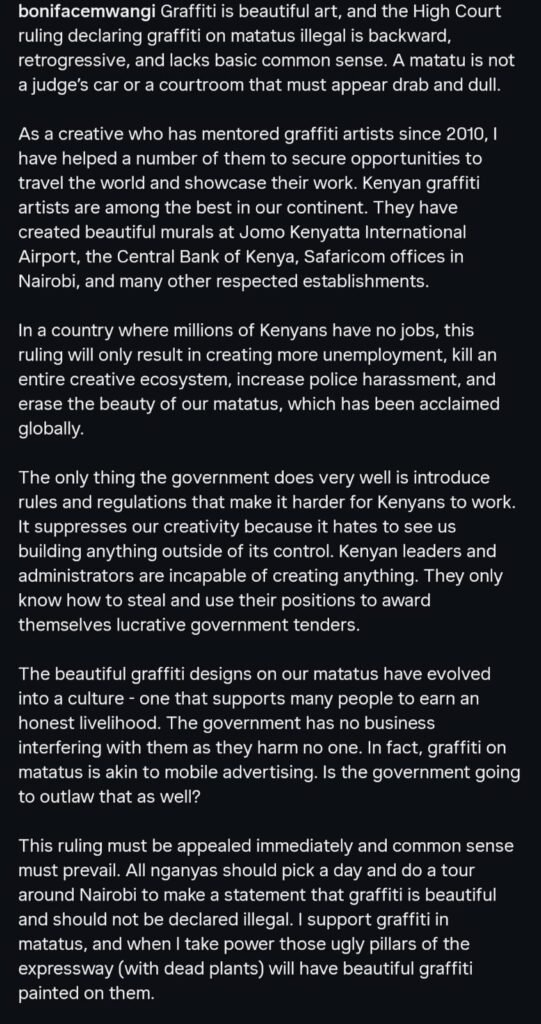
One of Mwangi’s strongest arguments centered on the economic impact of the ruling. He said in a country already battling widespread unemployment, the ban would destroy an entire creative economy that supports many young people.
“In a country where millions of Kenyans have no jobs, this ruling will only result in creating more unemployment, kill an entire creative ecosystem, increase police harassment and erase the beauty of our matatus, which has been acclaimed globally,” he said.
For years, graffiti painters, graphic designers, spray artists, welders, audio technicians, and customizers have depended on the matatu industry for income.
Many popular matatus invest heavily in artwork, branding, interiors, lighting, and sound systems to stand out in Nairobi’s highly competitive transport scene.
Nairobi’s matatu culture has earned international attention for its bold graffiti, music, celebrity portraits, and pop culture themes.
Tourists often photograph the vehicles, while global media outlets have highlighted them as a uniquely Kenyan blend of transport and street art.
Mwangi said the colorful designs have evolved beyond decoration into a legitimate culture that many families depend on.
“The beautiful graffiti designs on our matatus have evolved into a culture — one that supports many people to earn honest livelihood,” he said.
He also argued that the government should not interfere with a harmless form of expression.
“The government has no business interfering with them as they harm no one. In fact, graffiti on matatus is akin to mobile advertising,” he added.
Mwangi urged authorities to challenge the ruling immediately, insisting that common sense must prevail.
“This ruling must be appealed immediately and common sense must prevail,” he said.
He further called on matatu operators, popularly known as nganyas, to organize a symbolic show of unity by parading across Nairobi.
“All nganyas should pick a day and do a tour around Nairobi to make a statement that graffiti is beautiful and should not be declared illegal,” he proposed.
Mwangi also shared how he would integrate graffiti into public infrastructure if given the chance to lead.
“I support graffiti in matatus and when I take power those ugly pillars of the expressway (with dead plants) will have beautiful graffiti painted on them,” he said.
He suggested that graffiti artists could also be encouraged to tell deeper stories through their work by honoring African heroes and history.
“The only thing I would encourage graffiti artists to do is start painting the faces and stories of Kenyan and African histories,” he concluded.
The ruling has triggered mixed reactions online, with some supporting cleaner and more regulated public transport, while others argue the decision unfairly targets a thriving creative movement.


