




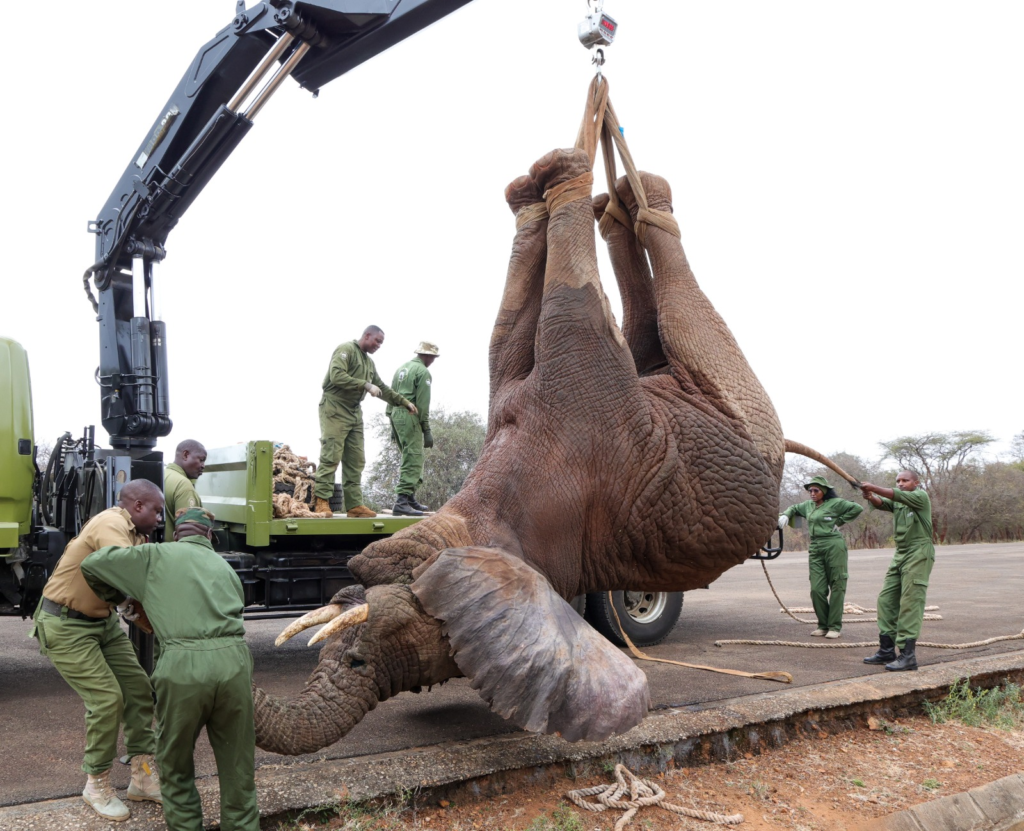
NAIROBI, Kenya- The Kenya Wildlife Service (KWS) has launched a six-day operation to relocate five elephants from Mwea to a protected habitat in a bid to reduce persistent human-wildlife conflict that has disrupted farming activities in Kamburu and Kivaa.
In a statement issued on Monday, KWS said the translocation exercise is aimed at easing tensions between local communities and elephants that have repeatedly strayed into farms, destroying crops and threatening livelihoods.
The agency noted that the incursions have left many farmers living in fear as they struggle to protect their farms from the roaming animals.
Farmers Face Months of Crop Destruction
According to KWS, communities in Kamburu and Kivaa have endured months of crop losses caused by elephants wandering into farmlands, increasing the risk of dangerous encounters between people and wildlife.
The agency said relocating the animals to a more suitable habitat will help safeguard both residents and the elephants.
“The translocation exercise is intended to ease the conflict by moving the elephants to a habitat that is better suited to their needs while improving the safety of surrounding communities,” KWS said.
Two Elephants Already Relocated
KWS confirmed that the operation got underway successfully, with two elephants relocated on the first day of the exercise.
The remaining three elephants are expected to be moved over the coming days as the six-day operation continues.
“On the first day, two elephants were successfully moved, with the remaining translocations continuing over the coming days,” the agency said.
Balancing Conservation and Community Safety
KWS said the relocation is expected to deliver long-term benefits for both local communities and wildlife by reducing crop destruction while giving the elephants access to a habitat with adequate food, water and space.
The agency described elephant translocation as a complex conservation undertaking that requires extensive planning, scientific expertise and specialised field teams.
“Elephant translocations are complex conservation operations, requiring careful planning, scientific expertise, and dedicated field teams. Every successful move is another step toward safer communities, thriving wildlife, and lasting coexistence,” KWS said.
Monitoring After Relocation
KWS said the relocated elephants will be closely monitored after the exercise to ensure they adapt successfully to their new environment.
The agency reaffirmed its commitment to promoting peaceful coexistence between people and wildlife through conservation interventions aimed at reducing conflict while protecting Kenya’s biodiversity.



