




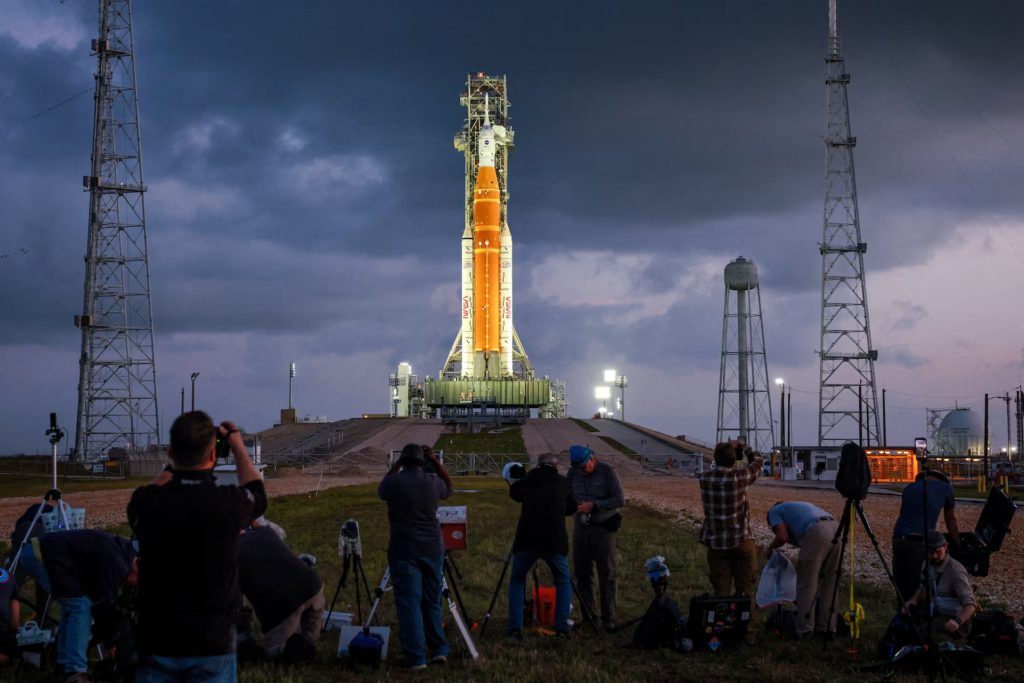
CAPE CANAVERAL, United States — NASA on the night of 1st April 2026 launched Artemis II aboard the Orion spacecraft, powered by the Space Launch System, marking humanity’s return to deep space more than five decades after the Apollo era.
The mission represents the first time astronauts will travel beyond low Earth orbit since Apollo 17 in December 1972. That flight ended the Apollo program, which began with Apollo 8 and reached its defining moment with Apollo 11.
Since then, human spaceflight has focused largely on orbital missions, including the Space Shuttle program and long-duration habitation aboard the International Space Station.
Artemis II builds on the uncrewed success of Artemis I in 2022, which sent Orion around the moon and back, validating navigation, propulsion, and high-speed re-entry systems.
The upcoming mission advances those tests into a human environment, with a four-member crew scheduled to spend about 10 days in deep space.
After launch, Orion will enter Earth orbit for system checks before performing a translunar injection burn that accelerates the spacecraft toward the moon. The trajectory then transitions into a coast phase governed by gravitational forces from Earth and the moon.
Rather than entering lunar orbit, Artemis II will follow a free-return trajectory — a path first used by Apollo missions — allowing the spacecraft to swing around the moon and return to Earth with minimal propulsion.
At its farthest point, the crew is expected to travel farther from Earth than any humans before them, surpassing the distance reached by Apollo 13. The spacecraft will then accelerate back toward Earth, with Orion’s heat shield protecting the crew during high-speed atmospheric re-entry before splashdown in the Pacific Ocean.
The crew — Reid Wiseman, Victor Glover, Christina Koch, and Jeremy Hansen — brings experience from missions aboard the International Space Station. The flight will test life-support systems, deep-space communications, crew operations, and radiation exposure limits needed for future lunar missions.

NASA officials view Artemis II as a stepping stone toward human landings planned under Artemis III later in the decade. Those missions are expected to rely in part on the Starship as a lunar lander, reflecting a broader partnership between government and commercial space systems.
Beyond exploration, the Artemis program aims to establish sustained lunar activity, particularly near the moon’s south pole, where scientists believe water ice exists in permanently shadowed regions.
The resource could be converted into hydrogen and oxygen, enabling fuel production and supporting longer missions deeper into space.
Such infrastructure is seen as critical for eventual human missions to Mars. Long-duration travel, radiation exposure, and operational autonomy required for Mars exploration cannot be fully tested in low Earth orbit.
NASA planners view the moon as an intermediate proving ground for those capabilities.
Artemis II infers to reconnecting human spaceflight with deep-space exploration after a 54-year gap, validates technologies for future lunar landings, and lays groundwork for sustained operations beyond Earth orbit — a progression intended to culminate in human missions to Mars in the decades ahead.

