




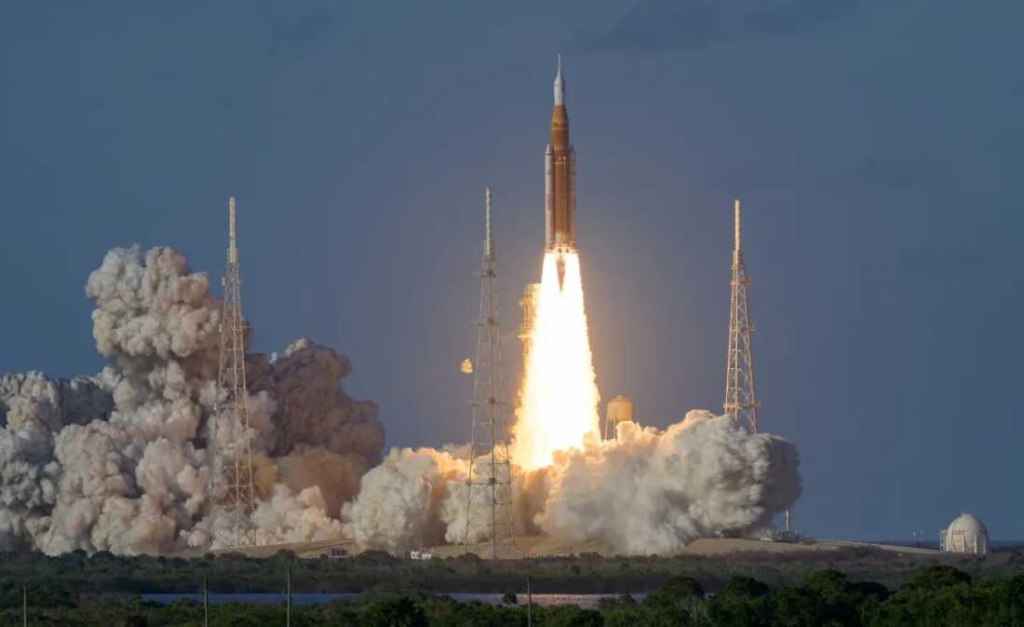
CAPE CANAVERAL, United States — NASA launched the Artemis II rocket on Wednesday evening, sending four astronauts toward the moon in the first crewed mission beyond low Earth orbit in nearly 54 years.
The spacecraft is currently orbiting Earth and will remain there until a scheduled translunar injection burn propels it on a roughly 240,000-mile journey toward the lunar environment.
Inside the Orion spacecraft capsule, the crew immediately began post-launch checks, assessing how the vehicle handled its 17,500 mph ascent to orbit.
Flight controllers confirmed that all four solar arrays deployed successfully, ensuring continuous electrical power for the spacecraft throughout the 10-day mission. The launch marks humanity’s first departure from low Earth orbit since Apollo 17 in December 1972.
“The nation, and the world, has been waiting a long time to do this again,” mission commander Reid Wiseman said before launch, as the multinational crew entered quarantine at Kennedy Space Center.

The crew includes three Americans and one Canadian: Christina Koch, Victor Glover, and Jeremy Hansen. Koch is set to become the first woman to travel into cislunar space, while Glover will be the first person of color to make the journey. Hansen will become the first non-American to travel that far from Earth.
The Orion capsule is expected to carry the astronauts farther from Earth than any humans before them. On flight day six, the crew will travel more than 4,600 miles beyond the far side of the moon, reaching nearly 253,000 miles from Earth and surpassing the record set by Apollo 13.
While the mission will not land on the moon, it is packed with technical milestones. Astronauts will test life-support systems, communications, navigation, and radiation protection needed for future lunar missions.
They will also photograph areas near the moon’s south pole where NASA plans to send astronauts during later Artemis flights.
The mission unfolds amid shifting political priorities. Diversity references previously highlighted in Artemis promotional material were scaled back following policy changes tied to an executive order by US President Donald Trump directing federal agencies to remove diversity, equity, and inclusion language.
Both Koch and Glover downplayed their “firsts,” emphasizing the broader human significance of exploration.
“I hope one day we don’t have to talk about these firsts,” Glover said before launch, adding that exploration should ultimately reflect “the story of humanity.”
NASA officials view Artemis II as a foundation for long-term lunar ambitions. Agency administrator Jared Isaacman has outlined plans for a $20 billion moon base by the end of the decade, with future missions expected to establish a sustained human presence near the lunar south pole.
During the mission, the astronauts will live within Orion’s five-meter-diameter cabin — roughly the size of a small camper van — while undergoing continuous health monitoring.
Scientists will study the effects of radiation exposure, microgravity, and crew dynamics during the 685,000-mile journey, which concludes with a Pacific Ocean splashdown.
Crowds estimated at up to 400,000 gathered along Florida’s Space Coast to witness the launch, underscoring renewed public interest in lunar exploration.
Engineers say the mission, though years behind schedule and billions over budget, is critical to returning humans to the moon for the first time in more than half a century.

