




NAIROBI, Kenya — National Intelligence Research University (NIRU) has crowned three students from Meru University of Science and Technology as winners of its 2025 National AI Hackathon, spotlighting emerging local technologies targeting healthcare, accessibility, and financial security.
Caroline Gakii, Daniel Maitethia, and Ezekiel Otieno secured the top prize of Sh2 million for developing a low-cost AI-powered digital microscope designed to improve access to cancer and malaria diagnosis.
The solution aims to enable affordable screening in resource-constrained settings by combining artificial intelligence with low-cost imaging hardware. Organisers said the project demonstrated strong potential for deployment in public health facilities and rural clinics.
Joshua Radula of Strathmore University emerged first runner-up, winning Sh750,000 for “Word 2 Sign,” an AI-powered tool that converts spoken or written language into sign language to improve accessibility for the deaf community.
Third place went to Kelvin Mulama, who received Sh500,000 for “Veritas AI,” a fraud detection platform designed to strengthen financial systems and identify suspicious transactions using autonomous intelligence models.
The hackathon attracted more than 5,600 registrations and generated over 2,500 AI solution submissions nationwide, reflecting growing interest in artificial intelligence as a tool for economic development.
Speaking during the Nairobi awards ceremony, NIRU Vice Chancellor James Kibon said the initiative aims to transform innovation into deployable products.
“What we are building is not just a competition, but a pipeline of deployable AI solutions. The quality of innovations we have seen demonstrates Kenya’s capacity to develop technologies that directly address our national priorities,” he said.
Nordin Hajji, chairman of the NIRU Board of Trustees and Director General of the National Intelligence Service, said the programme supports technological self-reliance and national resilience.
“By nurturing AI innovation locally, we are building the capacity to develop solutions that respond to our socio-economic realities while strengthening national security and economic resilience,” he said.
Interior Cabinet Secretary Kipchumba Murkomen commended participants, noting the innovations demonstrate Kenya’s growing digital leadership and potential to create jobs.
“The diversity and quality of solutions presented here demonstrate that Kenya has the talent and creativity to compete globally,” he said.
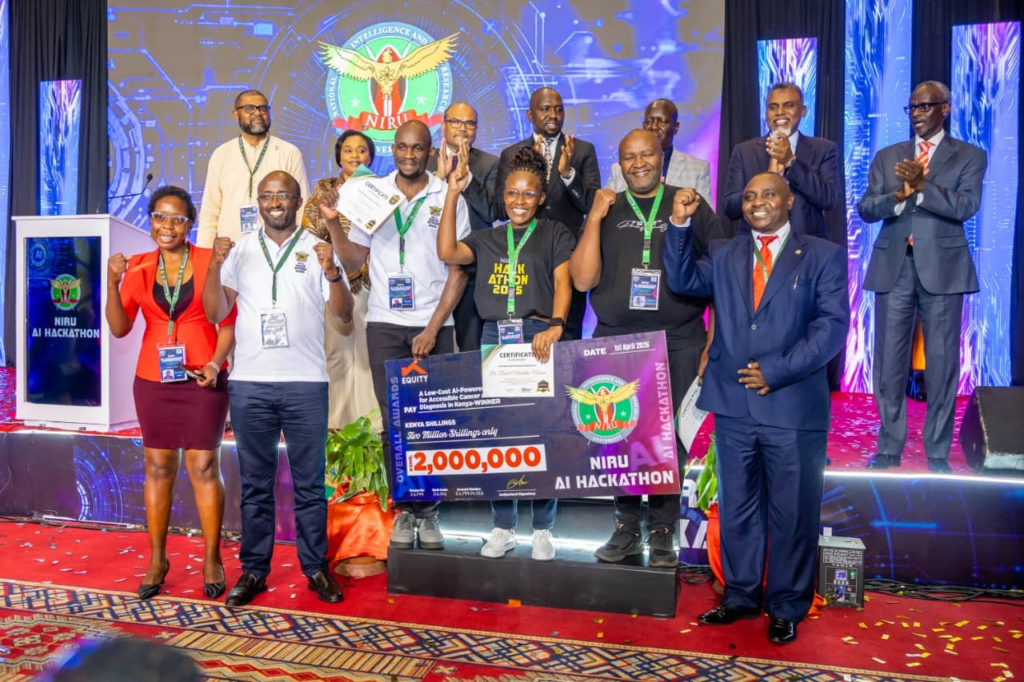
Organisers said participants underwent a structured incubation process that included technical mentorship, product development support, ethical AI guidance, and commercialisation training. Solutions were evaluated on national relevance, scalability, technical feasibility, originality, and measurable impact.
According to Chief Judge Ali Hussein Kassim, the winning entries showed readiness for real-world deployment across sectors, including security, agriculture, public service delivery, cybersecurity, and digital infrastructure.
The judging panel also included Juliana Rotich and other experts drawn from academia, industry, and the technology ecosystem.
Officials said the hackathon is intended to bridge digital talent with industry support, enabling promising innovations to scale into sustainable solutions that contribute to employment, security, and economic growth.

