




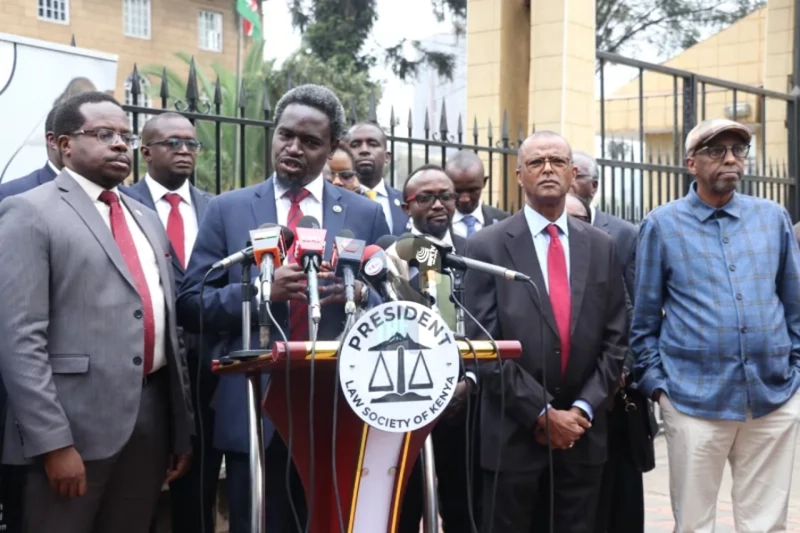
NAIROBI, Kenya- Court proceedings across Kenya were disrupted on Wednesday after lawyers stayed away from hearings in a one-day nationwide boycott called by the Law Society of Kenya (LSK), as the legal profession intensified pressure on the Judiciary over what it described as persistent administrative failures and inadequate judicial accountability.
The industrial action, led by LSK President Charles Kanjama, saw advocates refrain from participating in court hearings and applications while allowing limited court business to continue to safeguard urgent legal matters.
Under the boycott, lawyers continued filing court documents, while court mentions and applications involving interim orders proceeded only for the purpose of obtaining fresh hearing dates or extending existing interim orders.
Speaking on the action, Kanjama maintained that the protest was carefully designed to avoid completely paralyzing the justice system while drawing attention to longstanding concerns affecting the administration of justice.
“The boycott will not completely stall urgent legal deadlines,” Kanjama said, noting that advocates would continue handling matters necessary to preserve litigants’ rights.
Mounting Frustration with Judiciary
The LSK said the boycott followed years of unsuccessful engagement with the Judiciary over concerns that continue to affect advocates and litigants alike.
According to the society, it has held at least five formal consultative meetings with the Judiciary during the past two years, where several administrative and operational challenges were discussed, and action plans agreed upon.
However, the lawyers’ body argues that little meaningful progress has been achieved, leading to what it describes as a breakdown of confidence between the Bench and the Bar.
Among the issues raised are delays in hearing and determining cases, inefficiencies within court registries, case management challenges, and concerns over the mechanisms used to address complaints against judges and judicial officers.
The society also cited what it termed a growing culture of judicial impunity.
According to LSK, the immediate trigger for the boycott was the decision by some judges and judicial officers to obtain court orders restraining the Judicial Service Commission (JSC) and the Ethics and Anti-Corruption Commission (EACC) from investigating or processing corruption and misconduct complaints against them.
The society argues that such orders effectively shield judicial officers from accountability and undermine public confidence in the administration of justice.
Senior Advocates Join Protest
Several prominent members of the legal profession joined the boycott, including former LSK President Nelson Havi, Senior Counsel Philip Murgor, advocate Ndegwa Njiru, and Senior Counsel Ahmednasir Abdullahi, who has been among the Judiciary’s most vocal critics in recent years.
The presence of senior advocates underscored the profession’s growing dissatisfaction with the pace of judicial reforms and accountability measures.
Judiciary Keeps Courts Open
Despite the boycott, the Judiciary assured Kenyans that all courts across the country remained operational and continued hearing matters as scheduled.
In a statement issued ahead of the protest, the Judiciary said litigants and other court users should continue attending court, noting that judicial services would remain available throughout the day.
“The Judiciary assures the public that all courts throughout the Republic will remain open and will continue hearing and determining matters as scheduled on Wednesday, 22 July 2026,” the statement read.
The Judiciary added that parties whose advocates did not appear could still proceed with their matters, including representing themselves where necessary.
Judges Call for Dialogue
The Kenya Magistrates and Judges Association (KMJA) also appealed to the Law Society to suspend the boycott and instead pursue dialogue through existing justice sector mechanisms.
While acknowledging the legitimacy of several concerns raised by advocates, the association warned that the withdrawal of legal services would primarily affect ordinary litigants awaiting the resolution of their cases.
“Such engagement provides the most appropriate avenue for candid discussion, principled resolution of concerns and the strengthening of institutional cooperation in the public interest,” KMJA said in its statement.
The association reiterated its support for judicial accountability, adding that credible complaints against judicial officers should be investigated through the appropriate constitutional and statutory processes.
Consultative Meeting Scheduled
The Judiciary pointed to previous engagements with the legal profession, noting that five consultative meetings had already been held over the past two years to address operational challenges affecting the administration of justice.
It further confirmed that another high-level consultative meeting involving the Judicial Service Commission, the Law Society of Kenya Council and representatives of the Senior Counsel Bar has been scheduled for July 31, 2026.
Judicial officials expressed optimism that the upcoming meeting would provide an opportunity to resolve outstanding issues through dialogue rather than confrontation.


