




NAIROBI, Kenya — President William Ruto has said the development of the Mombasa Special Economic Zone (SEZ) will help transform the coastal city from a transit point for imported goods into a major centre for manufacturing, processing, logistics and exports.
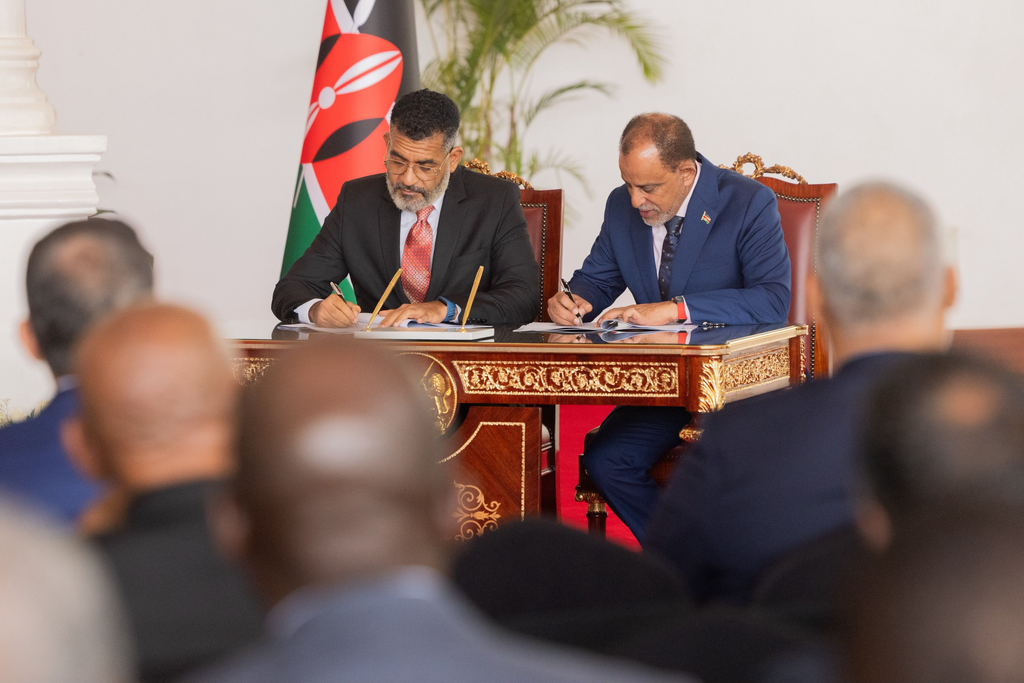
Ruto spoke on Tuesday, September 8, 2026, at State House Nairobi during the signing of a tripartite agreement between the County Government of Mombasa, Mombasa Free Zone Ltd and DP World for the development of the SEZ in Jomvu.
The President said the project formed part of his administration’s wider strategy to move Kenya from a trading and consumption-based economy towards one driven by production, manufacturing and exports.
“Today, we take another important step forward in Kenya’s ongoing transformation from a trading economy to a producing economy; from exporting raw materials to exporting finished goods; and from consuming what others produce to making more in Kenya for our own market, for Africa and for the world,” Ruto said.
Mombasa SEZ to cover 535 acres
The proposed Mombasa Special Economic Zone will occupy 535 acres in Jomvu, where it is expected to provide an integrated platform for manufacturing, warehousing, assembly, processing and export-oriented businesses.
Ruto said the partnership brings together government leadership, Kenyan enterprise and international expertise.
He described the agreement as a vote of confidence in Kenya and the Coast region, arguing that collaboration between government, private investors and international partners could accelerate industrialisation.
“Special Economic Zones are instruments for building industries, expanding exports, creating jobs, and connecting our farmers, entrepreneurs, and manufacturers to domestic, regional, and global value chains,” he said.
The President said the Government would continue positioning Kenya as an investment destination for businesses that bring productive capital, technology, skills, local supply chains and employment.
Ruto pushes manufacturing over raw exports
A central theme of Ruto’s speech was the need for Kenya and other African countries to process more of their raw materials locally.
He argued that exporting unprocessed commodities means African countries also lose potential jobs, industrial capacity and skills associated with processing and commercialisation.
“Every unprocessed commodity that leaves our shores carries with it the possibility of a factory that could have been built here, a job that could have been created here and an income that could have sustained a Kenyan family,” Ruto said.
The President said his administration wanted to reverse that pattern by encouraging more processing, manufacturing and value addition within Kenya.
“We will continue to trade with the world, but increasingly, what leaves our shores must carry Kenyan value, Kenyan enterprise, and Kenyan labour,” he said.
Ruto said the Mombasa SEZ would be one of the projects through which the Government intends to implement that strategy.
Port and transport links seen as key advantage
Ruto said Mombasa was particularly suited to become an industrial and logistics hub because of its location on the Indian Ocean and its access to the Port of Mombasa and regional transport corridors.
He said the SEZ would be connected to Kenya’s domestic market and wider African markets through the port, Standard Gauge Railway and road networks.
The President also pointed to the East African Community, COMESA and the African Continental Free Trade Area (AfCFTA) as potential markets for goods produced at the zone.
“Mombasa is uniquely positioned for this role. It must no longer be simply a place through which goods pass; it must increasingly become a place where goods are made, processed, assembled, branded, and exported,” he said.
The proposed development is therefore intended to combine industrial production with logistics and access to regional and continental markets.
Government promises cheaper power for SEZ investors
Ruto said the Government would support industrialisation by improving infrastructure and lowering production costs.
He announced a preferential electricity tariff of Sh10 per kilowatt-hour for Special Economic Zone investors, saying the measure was intended to make goods produced in Kenya more competitive.
“Our objective is straightforward; to lower the cost of production so that goods made in Kenya can compete successfully in regional and global markets,” he said.
The President also cited infrastructure projects around the Coast, including the Dongo Kundu Bypass, which he said had improved connectivity between Mombasa, the airport and South Coast.
He said completion of the Mwache Dam would strengthen water security in Mombasa and Kwale counties.
Ruto added that the Government was advancing plans to increase electricity generation to support energy-intensive manufacturing and Kenya’s expanding industrial base.
National Infrastructure Fund to finance strategic projects
The President said his administration was using the National Infrastructure Fund to establish a long-term mechanism for financing strategic infrastructure.
The fund is intended to support roads, electricity, water, rail and logistics infrastructure required to make industrial locations ready for investors.
“Our intention is clear; investors must find serviced locations ready for investment and operation, not industrial zones that exist only on paper,” Ruto said.
He also called for the benefits of the Mombasa SEZ to extend beyond the boundaries of the industrial zone.
The project, he said, should create business opportunities for farmers, transporters, contractors and small and medium-sized enterprises.
Jobs for Coast youth
Ruto said the development should provide employment and entrepreneurship opportunities for young people in Mombasa and the wider Coast region.
He identified potential opportunities in engineering, technical services, logistics, manufacturing and entrepreneurship.
“Our young people must not stand outside the gates of industrial transformation. They must design it, build it, operate it, and prosper from it,” he said.
At full development, Ruto said the zone was projected to mobilise substantial investment and create tens of thousands of direct and indirect jobs.
He acknowledged, however, that those projections would now need to be translated into an implementation programme with clear timelines and measurable results.
DP World expected to provide global expertise
Ruto welcomed the involvement of DP World, citing its international experience in ports, logistics and market connectivity.
The President said the company would help position the Mombasa SEZ as an internationally competitive industrial and logistics platform.
He also recognised Mombasa Free Zone Ltd for developing the project and the Mombasa County Government for making land available and facilitating local planning and community participation.
Other development partners mentioned in the speech included Afreximbank, which Ruto said had continued to support industrial parks and trade finance across Africa, and the International Finance Corporation, which he credited with contributing to the policy and governance framework for economic zones.
Government seeks integrated SEZ framework
Ruto said the Government was also consolidating the Export Processing Zones and Special Economic Zones programmes into a more integrated framework.
The aim, he said, was to improve coordination between investment promotion, industrial development and export growth.
He called for a government approach that would facilitate legitimate enterprise, remove unnecessary barriers and resolve obstacles facing investors quickly.
The President linked the Mombasa project to the AfCFTA, arguing that the continent’s free-trade ambitions would only deliver their full potential if African countries developed industries capable of supplying the continental market.
“The promise of continental free trade will be fulfilled not merely when we remove barriers at our borders, but when African factories produce the goods that move across them,” he said.
Ruto tells partners to move from agreement to implementation
With the agreement now signed, Ruto urged the three parties to move quickly from commitments to actual development.
“To all the parties signing this agreement today, my message is simple; move with speed. Let us move from signatures to implementation; from plans to infrastructure; from commitments to investment; and from investment to factories, exports, and jobs,” he said.
He also invited investors from Kenya, Africa and beyond to take advantage of the country’s location, infrastructure and market access.
“Bring your capital, technology, and bring your enterprise. Build here. Process here. Manufacture here. Employ here, and export from here,” Ruto said.
The President concluded by urging the partners to use the project to establish a new economic role for Mombasa — not only as Kenya’s gateway to the world but also as a production and manufacturing centre.
“Let us build in Mombasa. Let us make in Kenya. And let us sell to the world,” he said.


