




MERU, Kenya — President William Ruto has defended his frequent tours across the country, insisting they are part of his constitutional duty as Head of State, while appearing to renew his criticism of Standard Media Group over its scrutiny of his leadership and travel schedule.
Speaking on Sunday during the Service and 60th Anniversary celebrations at Burieruri Boys Senior School in Igembe Central, Meru County, Ruto dismissed critics questioning the frequency of his visits across the country, saying no one has the authority to dictate how he spends his time while serving Kenyans.
“I am surprised that many people are questioning my schedule. They are asking why I go here and why I go there. I ask them, why these questions when the time is not yours and the legs that are walking are not yours? What is your interest in where I am going?” the President said.
Ruto maintained that touring different parts of Kenya enables him to understand citizens’ needs firsthand and monitor the implementation of government development projects.
“There are people who do not understand the difference. They are saying that I have travelled around the country too much. I want to tell them that I am an employee of the people of Kenya and I have a responsibility to listen to Kenyans from every part of the country,” he said.
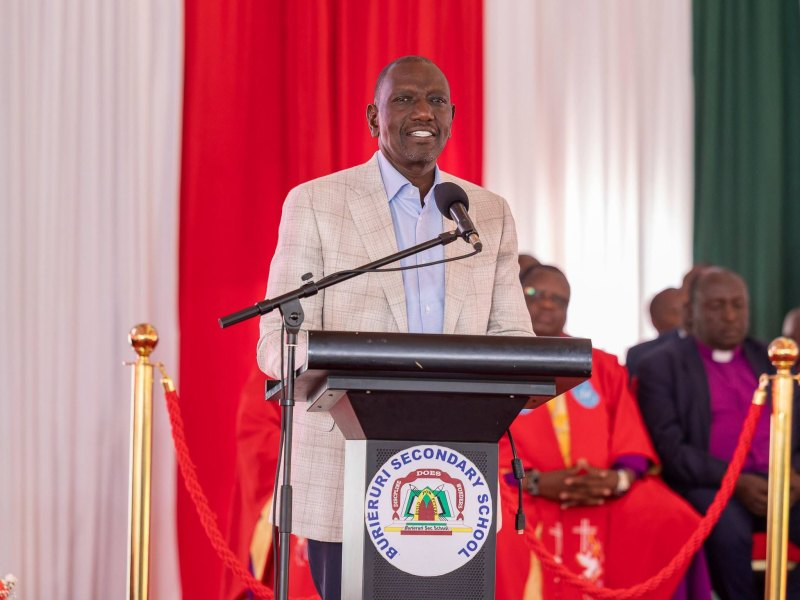
The President argued that physical visits to counties help identify development priorities that might otherwise be overlooked.
“If I had not come here myself, would these schools have been built? I will continue travelling across the country. I do not need anyone’s permission to use my time or my legs. I was employed by the people of Kenya,” he added.
His latest remarks come days after an escalating public exchange with Standard Media Group, which has sharply criticised his administration through a series of editorials and news coverage questioning governance, public spending, and the President’s extensive domestic tours.
The dispute began after Ruto accused the media house on social media of running what he termed an “extortionist propaganda” campaign against his administration.
Standard Media Group rejected the accusation, insisting its journalism is guided by facts, public interest, and professional ethics while defending its editorial independence.
Among its recent editorials, the media house questioned the value of the President’s numerous countrywide tours, suggesting they were accompanied by expensive convoys, helicopter travel, and substantial mobilisation costs.
Without mentioning Standard directly on Sunday, Ruto defended the visits as essential to effective leadership, saying he was redefining the presidency by remaining accessible to citizens rather than governing from Nairobi.
“I will continue visiting the whole country, and I won’t ask for anyone’s permission. Back in the day, there was discrimination because the president only visited select areas. Those asking me questions should know that I am not a king but a president employed by Kenyans,” he said.

The President further argued that previous administrations had neglected some regions, saying his government is committed to ensuring equitable development regardless of location.
“There was discrimination in the past. Every part of this country and every community deserves equal attention, and I will continue working to unite them,” he said.
Ruto has consistently defended his demanding work schedule. Earlier this month, he said his diary was booked six months in advance, insisting Kenya could not afford to slow down if it hopes to match the economic progress achieved by countries such as Singapore, Malaysia, and South Korea.
He argued that sustained engagement with citizens and close supervision of government projects remain central to his administration’s development agenda.


