




NAIROBI, Kenya – Nominated Senator Karen Nyamu has called for a national conversation on endometriosis and urged the government to address major gaps in the diagnosis, treatment and financing of the condition in Kenya.
Nyamu renewed her call for action following media personality Natalie Githinji’s recent hospitalisation and diagnosis with Stage IV endometriosis, saying her experience highlights the challenges faced by thousands of women living with the condition.
The senator said Kenya needs to move beyond awareness campaigns and develop practical measures that can improve access to specialised care, generate reliable data and reduce the financial burden placed on patients.
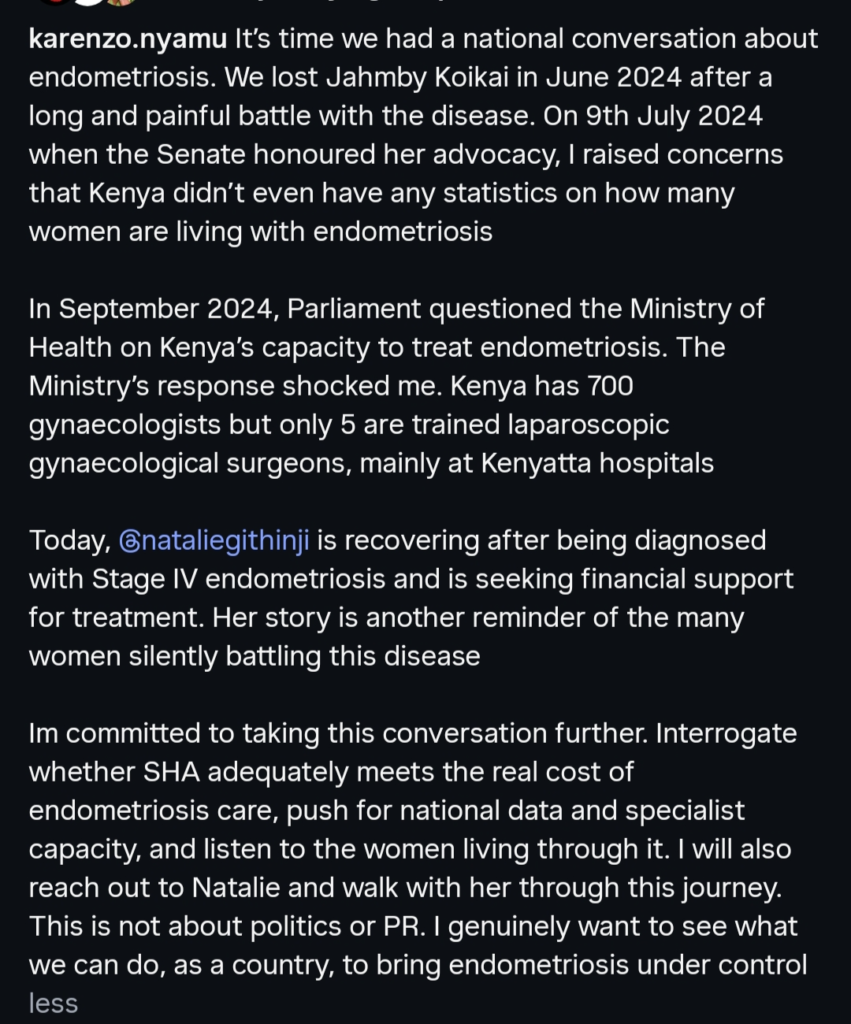
“It’s time we had a national conversation about endometriosis.” Nyamu said.
She linked her latest intervention to the legacy of the late endometriosis advocate Jahmby Koikai, who died in June 2024 after a long battle with the disease.
Koikai had spent years speaking publicly about her experience with endometriosis and advocating for better diagnosis and treatment for Kenyan women. Her death brought renewed attention to the seriousness of the condition and the challenges patients face in accessing specialised healthcare.
Nyamu recalled that when the Senate honoured Koikai’s advocacy in July 2024, she raised concerns about the absence of reliable national statistics showing how many women in Kenya live with endometriosis.
According to Nyamu, the lack of data remains a significant problem because it makes it harder for policymakers to understand the scale of the condition and plan appropriate healthcare services.
The senator subsequently pursued the issue in Parliament, with the Ministry of Health responding to questions about Kenya’s capacity to treat endometriosis in September 2024.
The response, she said, exposed another major gap in specialised healthcare.
Kenya has approximately 700 gynaecologists, but only five are trained in laparoscopic gynaecological surgery, according to the information cited by Nyamu. She said the few specialists are mainly based at Kenyatta hospitals, leaving many patients with limited access to specialised treatment.
“The Ministry’s response shocked me. Kenya has 700 gynaecologists but only 5 are trained laparoscopic gynaecological surgeons, mainly at Kenyatta hospitals.” she said.
The shortage is particularly significant for patients with severe endometriosis, who may require specialised surgical intervention. Nyamu argued that Kenya needs to expand its specialist capacity so that women do not have to struggle to find appropriate treatment.
She also wants the government to examine whether the Social Health Authority (SHA) provides adequate financial protection for women undergoing treatment for endometriosis.
Nyamu said policymakers should interrogate whether the current health insurance framework reflects the actual cost of managing the disease.
“Interrogate whether SHA adequately meets the real cost of endometriosis care, push for national data and specialist capacity, and listen to the women living through it.” she said.
Natalie’s case has added urgency to Nyamu’s advocacy. Githinji recently revealed that doctors diagnosed her with Stage IV endometriosis, the most severe stage of the disease, after she underwent surgery and spent time in intensive care.
The media personality has since spoken about her recovery and the physical, emotional and financial challenges associated with the diagnosis. She has also appealed for financial support as she continues her treatment and recovery.
For Nyamu, Githinji’s experience is a reminder that many women continue to battle endometriosis away from the public eye. She said the country must listen to these women and develop a healthcare system capable of responding to their needs.
“Her story is another reminder of the many women silently battling this disease.” Nyamu said.
The senator also said her intervention would include direct support for Githinji. She pledged to reach out to the media personality and support her during her recovery.
Nyamu maintained that her involvement is not motivated by political interests or publicity. Instead, she said she wants to use her position to help advance practical solutions to a health problem affecting women across the country.
“This is not about politics or PR. I genuinely want to see what we can do, as a country, to bring endometriosis under control.” she said.
Her renewed push comes at a time when endometriosis is receiving increased public attention in Kenya, partly because prominent women have shared their experiences with the condition.
The disease occurs when tissue similar to the lining of the uterus grows outside the uterus and can cause severe pelvic pain, heavy or irregular periods, painful intercourse, infertility and other complications. The condition can take years to diagnose, making awareness and access to specialised medical care important.


