




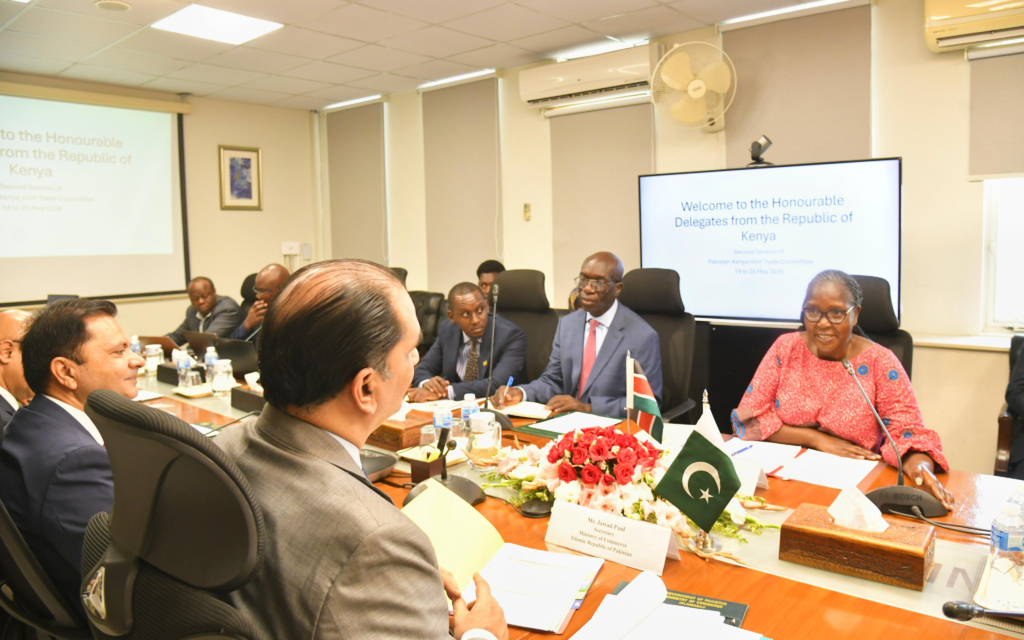
ISLAMABAD, Pakistan — Kenya and Pakistan have moved to deepen bilateral trade and investment ties following the Second Kenya-Pakistan Joint Trade Committee meeting held in Islamabad, with both countries pledging to accelerate economic cooperation across key sectors.
The Kenyan delegation was led by Principal Secretary for Trade Regina Ombam during discussions that focused on enhancing market access, customs cooperation, and business partnerships between the two nations.
According to Kenya’s trade officials, the meeting provided a platform for advancing long-standing commercial relations and reaffirmed the commitment of both governments to promote sustainable economic growth and shared prosperity.
The two countries agreed to strengthen customs collaboration, facilitate business-to-business linkages, and encourage participation in trade fairs and exhibitions. They also pledged to address non-tariff barriers that have continued to affect trade flows between Nairobi and Islamabad.
Officials said the talks underscored the need for sustained dialogue to unlock the full potential of the Kenya-Pakistan trade partnership amid growing global competition and shifting supply chains.
Kenya and Pakistan further committed to fast-tracking the conclusion of several Memoranda of Understanding (MoUs) covering trade promotion, customs cooperation, investment facilitation, standards and quality assurance, pharmaceuticals, information and communication technology, and tourism.
During the engagements, Kenya expressed interest in expanding exports of tea, coffee, avocados, flowers, leather products, halal-certified goods, dairy products, and other agricultural commodities into the Pakistani market.
On the other hand, Pakistan highlighted export opportunities in rice, pharmaceuticals, surgical instruments, tractors, sports goods, fruits, vegetables, spices, and engineering products.
The renewed push for stronger ties comes as Kenya seeks to diversify export destinations and attract foreign investment under its broader trade and industrialization agenda. Pakistan, meanwhile, is looking to strengthen economic partnerships within Africa through expanded trade and manufacturing cooperation.
Trade experts say improved market access and reduced non-tariff barriers could significantly boost trade volumes between the two countries, particularly in agriculture, manufacturing, and pharmaceutical sectors.
Kenya has, in recent years, intensified efforts to expand trade relations with Asian markets as part of its strategy to reduce overreliance on traditional export destinations in Europe and North America.
The Joint Trade Committee mechanism is expected to continue serving as a framework for monitoring the implementation of trade agreements and resolving emerging commercial challenges between the two countries.


