




NAIROBI, Kenya — Heavy overnight rains have paralysed movement across Nairobi, leaving major roads impassable, motorists stranded, and key transport corridors severely disrupted.
The worst-hit section is Mombasa Road, where flooding between Mlolongo and Cabanas brought traffic to a complete standstill early Saturday morning, May 1. Motorists reported being stuck for hours in massive traffic snarl-ups stretching several kilometres.
Witness accounts indicated traffic was backed up nearly 3km from the Ole Sereni area towards The Standard Media Group zone, with trucks and small vehicles immobilised in rising floodwaters.
Flooding was also reported near Jomo Kenyatta International Airport, further complicating movement along the critical airport corridor.
The Eastern Bypass was similarly affected and in some sections completely blocked, forcing motorists to divert to the Nairobi Expressway where possible. On the opposite end, congestion stretched from Nairobi’s Central Business District towards Athi River.
In the city centre, flooding disrupted major roads including Jogoo Road around Makadara and the Church Army roundabout, while Landhies Road linking OTC and Kamukunji was also submerged.
Videos and images showed sections of the Muthurwa Footbridge area overwhelmed by water, with drainage systems overflowing onto adjacent roads.
Commuter rail services were also affected, with reports indicating that the Nairobi commuter train from Syokimau could not proceed beyond Imara Daima Station due to flooded railway lines.
Along Lang’ata Road near the T-Mall area, a known flood hotspot, the road became impassable early in the morning before waters began receding around 7 a.m.
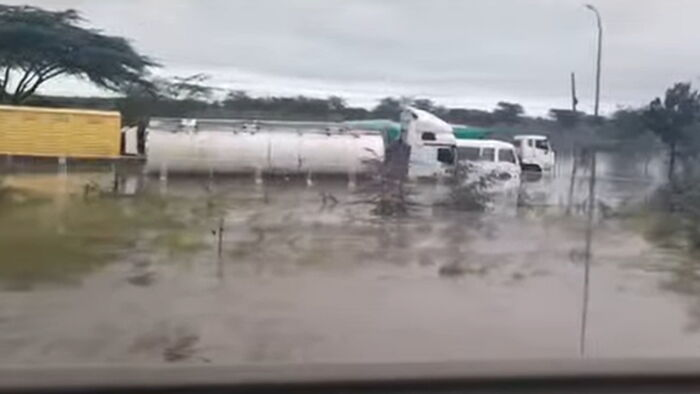
Witnesses reported at least two vehicles falling into a drainage ditch near a Shell petrol station, with one truck fully submerged. Police were dispatched to the scene to assist in recovery operations.
The Kenya Red Cross Society confirmed it was responding to distress calls in Mukuru kwa Njenga, where there are unconfirmed reports of missing persons and households cut off by floodwaters.
Authorities had earlier warned residents about rising water levels in Nairobi’s river systems. The National Police Service noted that rivers, including Nairobi, Mathare, Ngong, Kamiti, and Athi, had reached critically high levels due to sustained rainfall.
“These waterways all drain into the larger Athi River system, which is currently running at critically high levels,” police said in an earlier advisory.
Flooding is also being closely monitored in several vulnerable Nairobi estates, including Lang’ata, Ngara, Madaraka, Eastleigh, Kawangware, Kibera, South C, Kasarani, Mathare, Mlolongo, and Syokimau.
Emergency teams remain on high alert as the full extent of damage continues to be assessed, with authorities urging residents in flood-prone areas to avoid crossing flooded roads and drainage channels.
The heavy rains have once again exposed Nairobi’s drainage challenges, with recurrent flooding disrupting transport, commerce, and emergency response across the capital.


