




By Eunice Omollo,
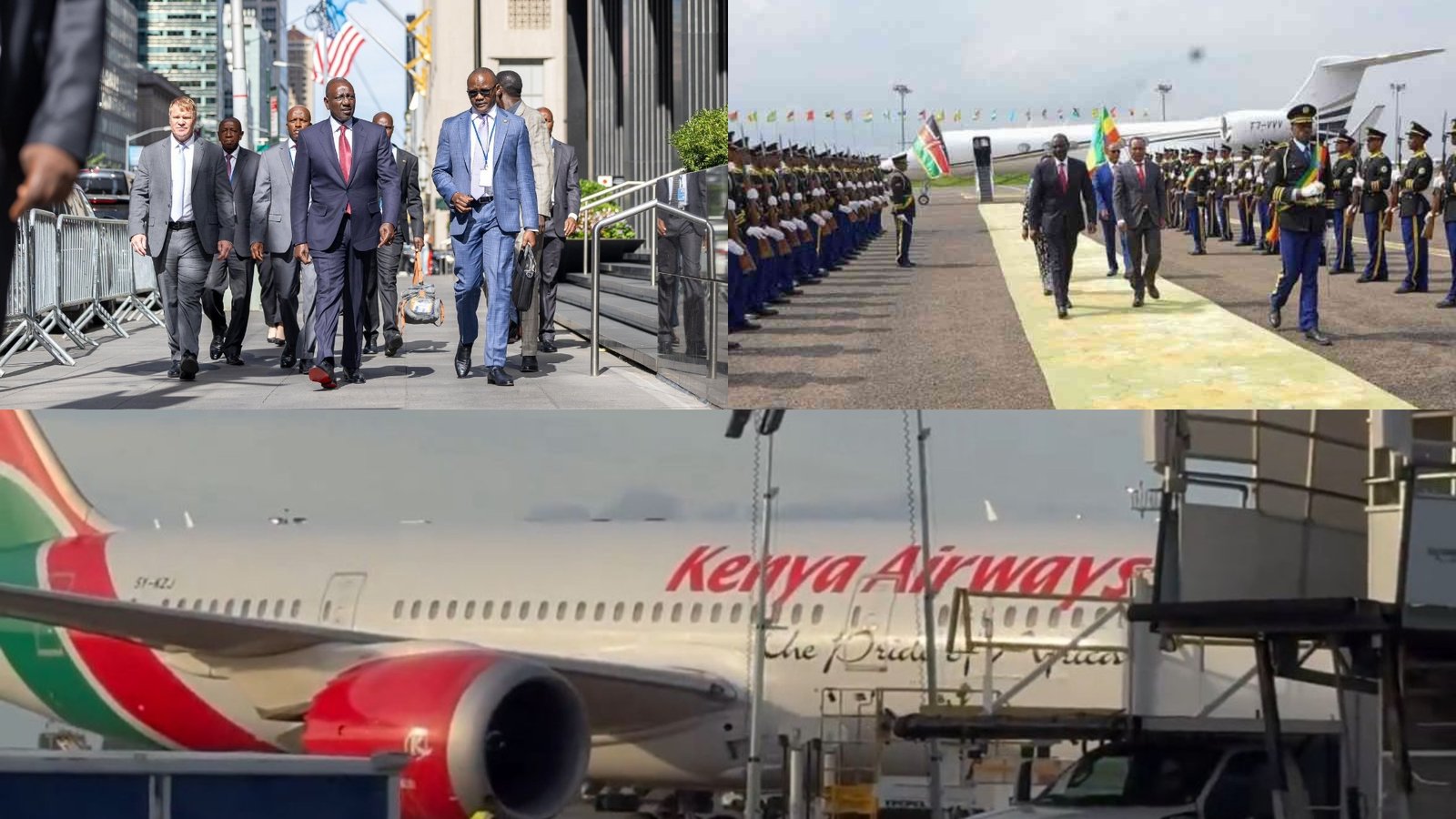
NAIROBI, Kenya-In the hush of the runway in Addis Ababa, the Gulfstream GV came to rest, its polished body gleaming like a trophy of power. President William Ruto’s arrival was choreographed in luxury.
Later, once settled in the Ethiopian capital, he stepped out draped in a flowing silk shirt, Cartier sunglasses perched on his face (eyewear retailing at nearly Sh167,000).
The ensemble announced extravagance before a word was spoken. Then came a flash of unexpected warmth: during the inauguration of the Grand Ethiopian Renaissance Dam, Prime Minister Abiy Ahmed broke from the stiff formality of statecraft.
He slipped behind Ruto and playfully gripped his shoulders, a gesture more fraternal than official, the kind of easy camaraderie you’d expect in a village square, not on a continental stage.
Fast forward to New York. The theatre was different: no hush of a private hangar, but the steady hum of Kenya Airways, the Pride of Africa, taxiing onto the runway.
When Ruto descended, this time without the flourish of silk and shades, the Ministry of Foreign Affairs framed the narrative carefully: “President William Ruto arrives in New York aboard Kenya Airways, the Pride of Africa, for the UN Summit, accompanied by First Lady Rachael Ruto.”
It was not a private spectacle but a national statement. Kenya, not just its leader, stepping into the global spotlight.
At the United Nations, Ruto’s message was blunt: “Africa’s exclusion from the United Nations Security Council is unacceptable and indefensible.”
His assertion tapped into long-standing frustrations over the continent’s marginalisation in global decision-making.
Kenya, he said, would “fully support Africa’s demand for representation,” while challenging African leaders to unite behind the Common African Position and to be “ready to shoulder the responsibilities of permanent membership, including agreeing on how we will choose our representatives.”
It was vintage Ruto: the grand phrases, the sweeping urgency, the conviction of a man convinced history is within reach.
But his New York script was not all about structural reform. He also cast himself as a peace diplomat. After talks with Finland’s President Alexander Stubb, he declared: “We value our close diplomatic ties with Finland and are committed to strengthening cooperation in areas of mutual interest… especially in advancing global and regional peace and security.”
He listed Gaza, Ukraine, Sudan, the DRC, and Somalia as arenas where Kenya was actively aligned with the search for stability.
On Palestine, Ruto sharpened the tone: “Kenya is proud of its role as a steadfast defender of peace and stability, both within our region and across the world. We support the pursuit of lasting stability in the Middle East through a two-state solution, where Israel and Palestine live side by side in mutual respect and peaceful coexistence. Kenya has recognised the Statehood of Palestine since 1989.”
This was no throwaway line. By revisiting Kenya’s recognition of Palestine, a fact often buried in diplomatic history, Ruto was threading Nairobi’s reputation as a mediator into the fraught politics of the Middle East. It was a move that played well to African solidarity while burnishing Kenya’s credentials as a neutral broker.
Yet, behind the flourish of diplomacy lies a sharper question: does Kenya have the heft to back Ruto’s big talk?
His climate finance speeches drew applause; his pitch for Kenya as Africa’s investment hub sounded convincing; and his calls for global financial reforms echoed a continent’s frustration.
Still, for many back home, those lofty statements clash with daily struggles: high living costs, youth unemployment, and a trust deficit in government.
Ruto has a knack for bold declarations. He told world leaders that climate change cannot be tackled without Africa, reminding them that the continent holds 60% of the world’s renewable energy resources.
He called for reforms in global financial systems, arguing that current models trap African economies in debt dependency.
On social media, he doubled down: “Kenya will continue to be at the forefront of advocating for reforms that make multilateral institutions inclusive, representative and just.”
Ruto’s genius, however, may lie in performance. He understands that power is as much about perception as policy. Whether stepping off a Gulfstream in Addis or the Pride of Africa in New York, he is choreographing Kenya’s image on the world stage.
His challenge now is to ensure that the spectacle carries weight beyond the runway and that his diplomacy translates into tangible gains for the millions who entrusted him with power.
Because while his rhetoric resonates, the real question lingers: does the substance match the grandiosity, or is it all silk, shades, and soundbites?
The writer, Eunice Omollo, is an award-winning journalist reporting on Science, Health, and Global Affairs.