




NAIROBI, Kenya — Nairobi Senator Edwin Sifuna has criticised President William Ruto’s directive for Tata Chemicals Magadi to leave Kenya, warning that allowing the executive to shut down businesses without predictable dispute-resolution mechanisms could undermine investor confidence and job creation.
Sifuna argued that investors need certainty over how commercial and regulatory disputes will be resolved, saying presidential directives to close businesses risk weakening the rule of law.
“When companies make decisions about where to put their investments, the dispute resolution regime in place is key because disputes arise all the time,” Sifuna said in a statement posted on social media.
He criticised what he described as a “Mambo Matatu, pack and go” approach in which the President can effectively order a business to shut down.
“The ‘Mambo Matatu, pack and go’ approach where the President can just shut down your business is very bad for investment and consequently, job creation,” he said.
Sifuna said his political movement, Linda Mwananchi, was pushing for a return to what he described as the rule of law.
“That’s why we in Linda Mwananchi insist on a return to the Rule of Law. That’s our Plan!” he said.
Ruto defends Tata Chemicals shutdown
Sifuna’s remarks came after President Ruto defended the government’s decision to halt Tata Chemicals Magadi’s operations during his tour of Kajiado County on Thursday, September 3, 2026.
Ruto accused the company, which has operated at Lake Magadi since 1911, of extracting Kenya’s natural resources without generating sufficient local economic opportunities.
The President said the government would seek a new investor to develop the resources around Lake Magadi, but under conditions requiring substantial local value addition.
“We have Lake Magadi. We have resources that can change Kajiado and Kenya,” Ruto said.
Ruto criticised Tata Chemicals for what he described as inadequate investment in industries within Kajiado and insufficient employment opportunities for local residents.
“They have not even built any industry in Kajiado. Let them go,” he said.
The President also accused the company of taking resources extracted in Kenya to India and other countries without creating enough downstream industries locally.

Government plans new glass and chemical industries
Ruto said the proposed replacement investor would be required to establish major manufacturing facilities in Kajiado.
According to the President, the plan would include a large glass manufacturing plant and another facility to process chemicals.
The government argues that requiring greater local processing would allow Kenya and Kajiado residents to capture more economic value from minerals extracted in the region.
Ruto posed the question of who should benefit from the natural resources around Lake Magadi.
“Who will develop Kajiado?” the President asked.
The comments signal the government’s intention to move beyond extraction of raw materials and promote local manufacturing and mineral beneficiation.
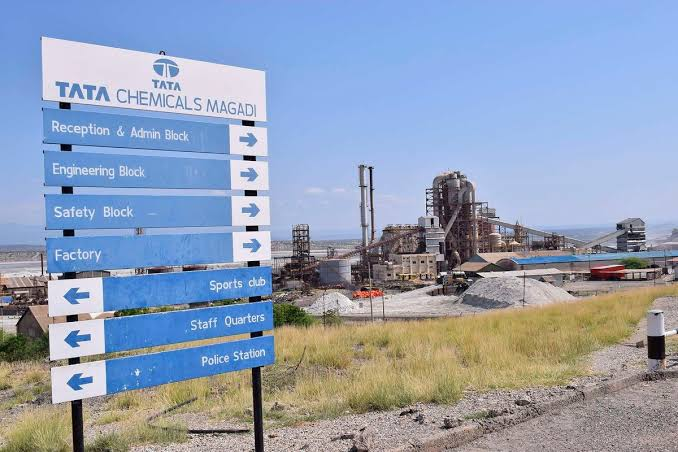
Tata Chemicals operations suspended since July
Mining Cabinet Secretary Hassan Joho subsequently cited outstanding compliance issues, including concerns relating to mineral beneficiation and value addition, royalty reconciliation and export reporting.
Tata Chemicals has maintained that it submitted documentation addressing the government’s concerns and has been awaiting further direction.
The company has also confirmed that its mining operations have remained suspended since July 28 in compliance with the government’s directive.
Tata Chemicals Magadi describes itself as Africa’s largest soda ash manufacturer and has operated at Lake Magadi for more than a century.

Sifuna raises wider investment concerns
For Sifuna, however, the dispute is about more than the future of one mining company.
He argued that businesses need confidence that disagreements with the government or regulators will be handled through established legal and dispute-resolution processes rather than abrupt executive directives.
His warning centres on the potential effect of government actions on Kenya’s reputation as an investment destination.
The senator linked predictable dispute resolution to both investment decisions and employment, arguing that uncertainty over whether a business can continue operating could discourage investors from committing capital.



