




NAIROBI, Kenya — The government has established a six-member committee to oversee the recruitment of a new chairperson and commissioners of the National Cohesion and Integration Commission (NCIC), as the current team’s term nears its end.
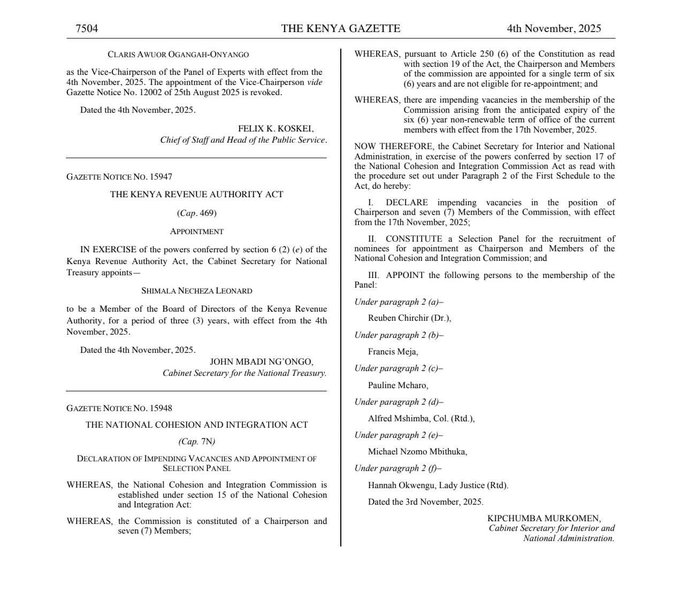
In a gazette notice dated November 4, Interior Cabinet Secretary Kipchumba Murkomen announced the formation of the panel, which will guide the recruitment process in line with the National Cohesion and Integration Commission Act.
The panel includes Dr Reuben Chirchir, Francis Meja, Pauline Mcharo, Col. (Rtd.) Alfred Mshimba, Michael Nzomo Mbithuka, and Lady Justice (Rtd.) Hannah Okwengu.
“The Cabinet Secretary for Interior and National Administration, in exercise of the powers conferred by Section 17 of the NCIC Act, hereby declares impending vacancies and constitutes a selection panel for the recruitment of nominees for appointment as chairperson and members of the commission,” the notice reads.
According to the law, the chairperson and members will serve a single six-year term and will not be eligible for reappointment. The current commissioners’ tenure is set to expire on November 17, 2025.

Congratulations to the selection panel for the recruitment of new members to the National Cohesion and Integration Commission (NCIC), following the declaration of impending vacancies.We are confident the panel will uphold integrity, fairness, and transparency in this important
Renewed Pressure Over Hate Speech
The announcement comes at a time of heightened political tension and growing concern over the resurgence of hate speech, ethnic profiling, and incitement as Kenya edges closer to the 2027 General Election.
Earlier this week, senators threatened to disband the NCIC over what they termed its “inaction and casual approach” to curbing hate speech and promoting national unity.
Appearing before the Senate National Cohesion and Regional Integration Committee, NCIC CEO Daniel Giti faced tough questioning from lawmakers who accused the commission of failing to address the surge of inflammatory remarks — especially on social media.
“If you (NCIC) don’t take charge, this country will go down as such utterances are on the rise — hate speech, propaganda for war, and negative ethnicity,” said Nominated Senator Catherine Mumma.
Her colleagues Beth Syengo, Betty Montet, and Joyce Korir echoed similar sentiments, demanding “concrete measures” rather than reports and awareness campaigns.
“We don’t want stories but results,” Korir said. “You are too casual in your work, and this is shameful.”
Monitoring Digital Platforms
Giti defended the agency, saying it continues to monitor both traditional and online media to detect and curb hate speech.
He said the commission had intensified digital literacy and ethical communication training, while working with the Communications Authority of Kenya (CAK) and the National Gender and Equality Commission (NGEC) to track and prosecute offenders.
CAK Director-General David Mugonyi confirmed that the authority provides both commissions with evidence from radio, TV, and social media to support enforcement.
“The Communication Authority works closely with both the NCIC and NGEC by providing evidence whenever there are hate speech cases,” Mugonyi said.
Last year, NCIC Chairperson Samuel Kobia reported that the commission had intervened in 95 cases of online hate speech, including 72 on X.
Political Tensions Ahead of 2027
Legislators have repeatedly warned that the rise in inflammatory political discourse could plunge the country into renewed ethnic and political tensions, similar to the 2007–08 post-election violence.
As the NCIC prepares for a leadership transition, the new team will face immediate pressure to restore public confidence and enforce accountability among political actors.


