




NAIROBI, Kenya — A Kenyan court on Wednesday issued a landmark ruling mandating that wives must return dowry payments upon divorce and scrapping alimony, in a judgment that the presiding judge characterised as a strike against a system built on patriarchal assumptions.
The ruling represents a significant shift in family law, touching on customs, gender equality and the rights of married persons.
The court declared that upon a marriage dissolution, the dowry (bride-price) paid by the husband must be returned by the wife.
Simultaneously, the court ruled that the practice of awarding alimony to a divorced wife is incompatible with contemporary gender equality norms, describing it as rooted in “a patriarchal system in which men were seen as sole providers.”
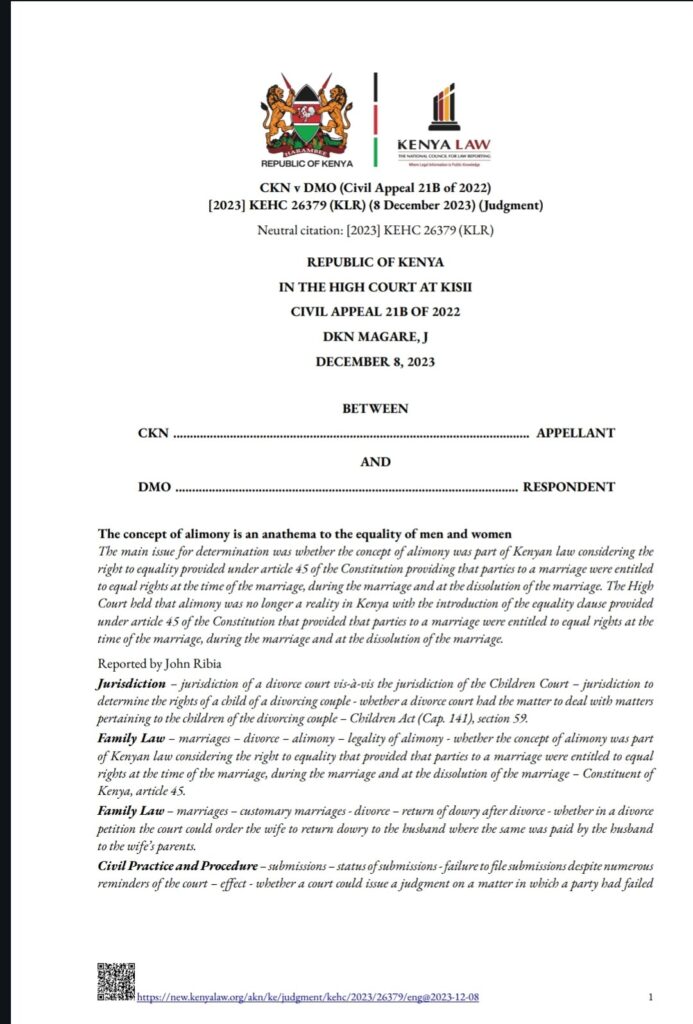
In Kenya, customary bride-price (dowry) is a common practice across many ethnic groups, and the payment of dowry is often considered a formal component of marriage. The court’s demand for its return after divorce marks a major development in how marriage breakdowns may be treated under law, especially where customary law intersects with statutory frameworks.
By eliminating alimony, the judgment challenges long-standing assumptions about spousal dependency post-marriage. The court’s reasoning—namely that awarding alimony treats spouses as unequal—signals a move toward enforcing greater gender parity within matrimonial regimes.
The ruling is likely to have wide-ranging implications for divorce proceedings in Kenya:
- Divorcing spouses may now face new legal financial consequences regarding dowry return and absence of alimony awards.
- Customary marriage practices may come under increased scrutiny, particularly where dowry is involved and marriage dissolution occurs.
- Legal practitioners and couples will need to reassess their expectations around spousal support and resource sharing post-marriage.
- Women who may have relied on alimony might face economic vulnerability unless other mechanisms of support are put in place.
Some social commentators have welcomed the ruling as aligning with constitutional principles of equality and fairness. Others warn it may destabilise customary marriage norms and leave vulnerable spouses with fewer protections.
It remains to be seen how this ruling will be operationalised across the country—whether it will prompt legislative amendments to reflect the court’s reinterpretation, or how cultural practices will adapt. Until then, it stands as a provocative recalibration of marital rights and duties in Kenya’s evolving legal landscape.
— Reporting by Kelvin Mutua


