




LONDON, United Kingdom — Two critically endangered frog species found only in Ghana’s Atewa Hills Forest Reserve have been moved to the London Zoo as conservationists intensify efforts to prevent their extinction amid growing threats from habitat destruction and mining activities.
The species, the Atewa slippery frog and Afia Birago’s puddle frog, are among the rarest amphibians in the world and survive only within limited habitats in the Atewa forest ecosystem in eastern Ghana.
The Atewa slippery frog, scientifically known as Conraua sagyimase, was formally described to science in 2021 and is already listed among the world’s Evolutionarily Distinct and Globally Endangered (EDGE) species. Conservationists estimate that fewer than 1,500 individuals remain in the wild.
Known for its unusual fish-like swimming ability and distinctive whistling call, the frog faces mounting threats from forest degradation linked to mining and human activity within its habitat.
Afia Birago’s puddle frog, Phrynobatrachus afiabirago, was identified in 2018 and is believed to survive in only two perennial pools inside the Atewa Hills Forest Reserve.
Weighing less than 1.75 grams, the species is considered highly vulnerable due to its extremely restricted range and the fragility of its habitat.
The conservation initiative is being led by the Zoological Society of London (ZSL) in partnership with Herp Conservation Ghana and the Forestry Research Institute of Ghana.
In September 2025, the organisations transferred 10 adult Atewa slippery frogs, 20 tadpoles, and 20 adult Afia Birago’s puddle frogs to London Zoo to establish a pioneering conservation breeding programme.
According to ZSL Curator of Reptiles and Amphibians Ben Tapley, the decision to relocate part of the population was driven by the urgent extinction risk facing both species and limited specialist amphibian care infrastructure within the region.
The frogs were initially housed in a behind-the-scenes habitat at London Zoo, where researchers and amphibian specialists worked to replicate their natural environment using field data collected from Ghana, including water samples and vegetation mapping.
The conservation programme has already recorded a breakthrough.
All Atewa slippery frog tadpoles successfully metamorphosed after arrival in London, and the species later bred successfully in captivity in November 2025, the first recorded captive breeding of the species anywhere in the world.
London Zoo amphibian keeper Unnar Aevarsson later travelled to Ghana to help establish the first dedicated amphibian conservation facility in West Africa, located in Kumasi.
The facility is expected to support long-term in-country breeding and future reintroduction efforts.
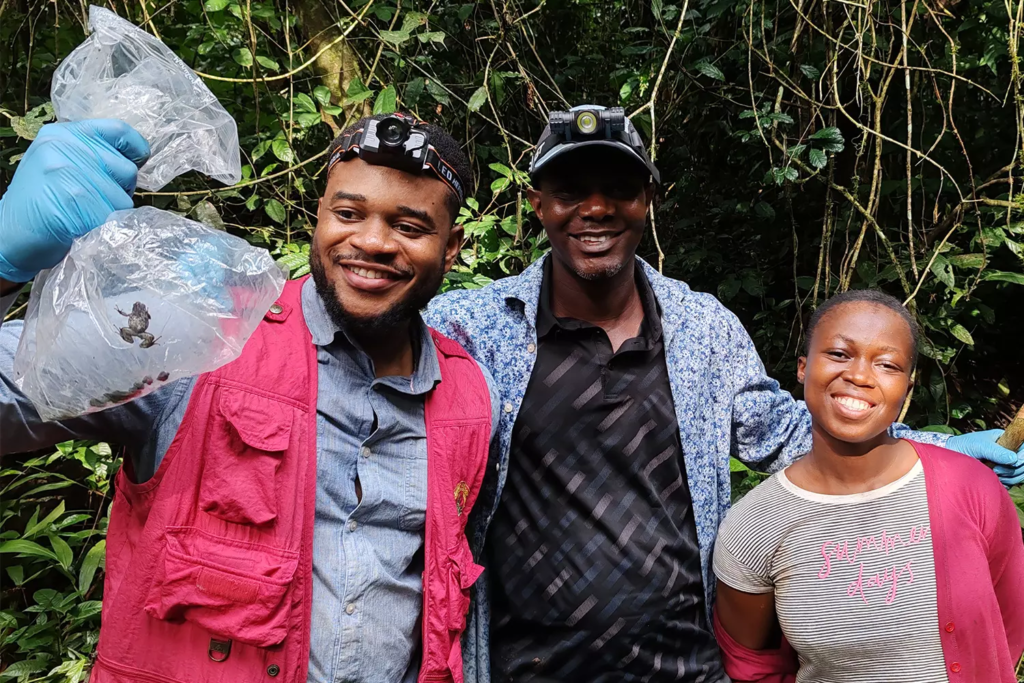
Conservationists say the programme aims not only to safeguard the frogs in captivity but also to develop sustainable breeding protocols that can eventually support restoration of wild populations.
Caleb Ofori-Boateng, Director of Herp Conservation Ghana and a regional programme manager for the EDGE of Existence Programme, played a central role in identifying and naming both species. Afia Birago’s puddle frog was named after his mother.
As part of the wider recovery plan, researchers are now exploring suitable habitats on private land surrounding the Atewa Hills Forest Reserve that could support future releases of frogs bred through the conservation programme.
Scientists warn that without urgent habitat protection and sustained conservation intervention, both species remain at significant risk of extinction in the wild.


