




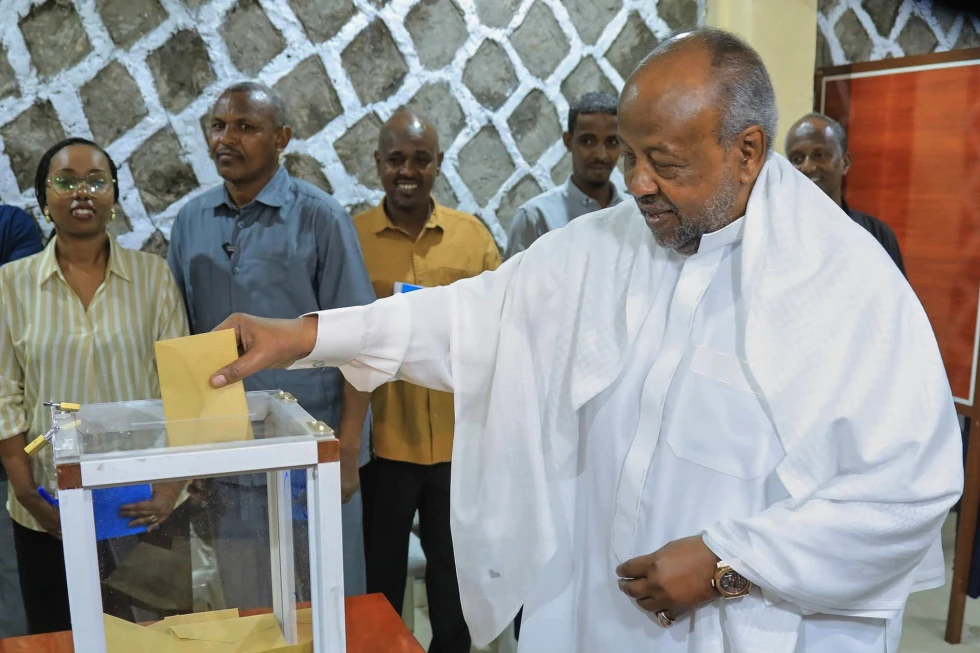
DJIBOUTI, Djibouti — Ismaïl Omar Guelleh has secured a sixth term in office after official results showed he won 97.81pc of the vote in Friday’s presidential election, extending his more than two-decade rule over the strategically positioned Horn of Africa nation.
The 78-year-old leader, who has been in power since 1999, faced a single challenger, Mohamed Farah Samatar, in a contest widely viewed by analysts as lacking genuine competition.
Election officials described the vote as peaceful, with celebrations erupting at the presidential palace following the announcement of the results.
Guelleh’s latest victory cements his grip on power in a country where opposition groups have frequently boycotted elections, citing restrictions on political freedoms and an uneven playing field.
His continued dominance has drawn criticism from human rights organisations, which accuse his administration of suppressing dissent and limiting democratic space.
The long-serving leader first assumed office after succeeding his uncle, Hassan Gouled Aptidon, establishing a political dynasty that has shaped Djibouti’s governance for decades.
A recent constitutional amendment removing the presidential age limit cleared the way for his re-election, despite earlier indications that he might step down.
Djibouti’s geopolitical significance has been central to Guelleh’s rule.
The country hosts multiple foreign military bases, including those of the United States, China, France, and Japan, positioning it as a key security and logistics hub along the Bab el-Mandeb Strait—a critical global shipping route linking the Red Sea to the Gulf of Aden.
Revenues from these bases, alongside port services for landlocked Ethiopia, form the backbone of the country’s economy.
However, economic challenges persist. Despite its strategic importance, Djibouti faces high unemployment, particularly among the youth, with estimates suggesting that up to 70pc of young people are jobless.
The country has also accumulated significant public debt, much of it tied to infrastructure financing, raising concerns about long-term economic sustainability.
Supporters of Guelleh argue that his continued leadership offers stability in a volatile region marked by conflict and political uncertainty.
The Horn of Africa has in recent years experienced instability in neighbouring countries, making Djibouti’s relative calm a key asset for international partners.
Critics, however, contend that stability has come at the cost of democratic accountability.
They argue that repeated landslide victories and limited opposition participation undermine the credibility of the electoral process and entrench authoritarian governance.
The election outcome is expected to reinforce Djibouti’s current political trajectory, with Guelleh maintaining tight control over state institutions and policy direction.
At the same time, it raises renewed questions about political reform, inclusivity, and the future of leadership succession in the small but strategically vital nation.



