




NAIROBI, Kenya – The Office of the Director of Public Prosecutions (ODPP) has issued a public alert outlining key signs of human trafficking, urging Kenyans to remain vigilant and report suspected cases to help curb rising incidences in the country and across borders.
In a statement issued as part of a broader public sensitization campaign, the ODPP said trafficking victims often exhibit specific physical, psychological, and behavioral signs that may indicate they are in distress or under coercion.
“Victims may have physical injuries or signs of torture, appear anxious or disoriented, and often avoid speaking freely,” the ODPP said. “They may also seem fearful of law enforcement or unwilling to engage with others.”

Trafficking in persons isn’t always obvious.𝐊𝐧𝐨𝐰 𝐭𝐡𝐞 𝐢𝐧𝐝𝐢𝐜𝐚𝐭𝐨𝐫𝐬 𝐨𝐟 𝐚 𝐩𝐨𝐭𝐞𝐧𝐭𝐢𝐚𝐥 𝐯𝐢𝐜𝐭𝐢𝐦.#HakiNaUsawa #CounterHumanTrafficking #KnowTheSigns
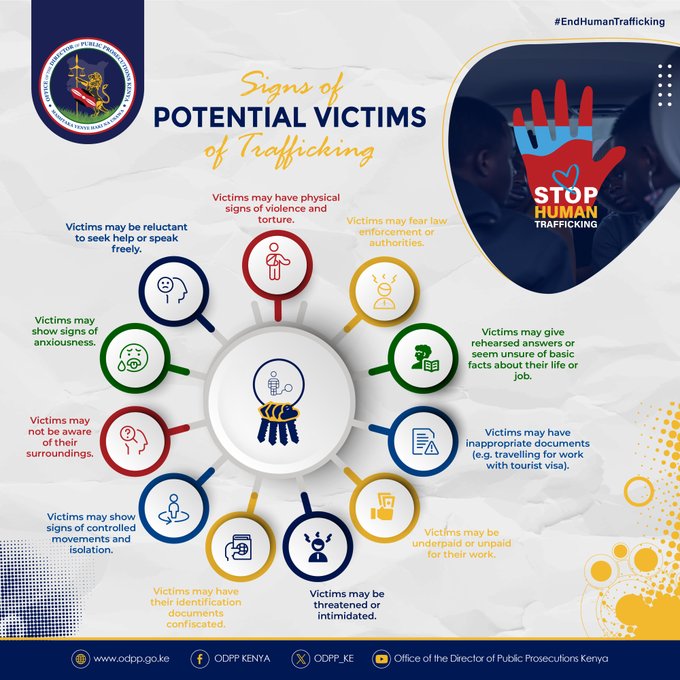
The agency noted that many victims are controlled by traffickers and may exhibit signs such as restricted movement, being constantly monitored, or giving rehearsed responses when asked basic personal questions.
Another red flag is irregular documentation. Victims may carry inappropriate or expired papers—for instance, holding tourist visas while claiming to be employed locally.
In many cases, traffickers confiscate their identity documents, making escape or legal recourse even harder.
In terms of working conditions, the ODPP highlighted that many trafficked individuals are underpaid or not paid at all and are frequently subjected to threats and intimidation to prevent them from leaving or seeking help.
The public alert is part of a nationwide awareness campaign spearheaded under the hashtag #EndHumanTrafficking, targeting high-risk sectors including transport, hospitality, and border control.
The ODPP is calling on members of the public, especially frontline workers in hotels, matatus, airports, and other travel hubs, to be extra vigilant and report suspicious activity through appropriate channels.
“These individuals may not even know where they are, let alone how to seek help. The public has a crucial role to play in ending this crime,” the statement read.


