




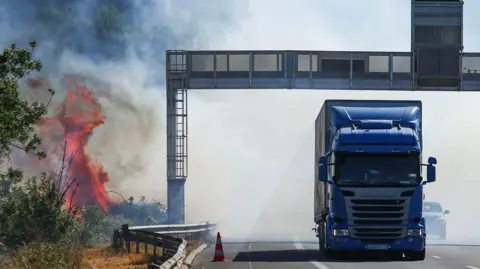
PERPIGNAN, France — More than 10,000 people have been evacuated from southern France after a rapidly spreading wildfire engulfed thousands of hectares of land near the Spanish border, prompting authorities to warn that strong winds could further intensify the blaze.
The fire, burning near Trévillach in the Pyrénées-Orientales department close to Perpignan, has destroyed at least 4,600 hectares of vegetation, according to local prefect Pierre Regnault de la Mothe.
Interior Minister Laurent Nunez said firefighters were facing deteriorating conditions as they battled the flames.
“This morning conditions are deteriorating again. Today the battle resumes,” Nunez said during an interview with French broadcaster TF1.
Thousands evacuated
Authorities ordered the evacuation of residents from more than a dozen towns and villages in the foothills of the French Pyrenees as the wildfire advanced towards populated areas.
Patrice, a resident of Trévillach, described the speed at which the fire spread.
“It came within 300 metres of the houses. We were shocked by how fast it spread. It was staggering, bordering on panic,” he told AFP.
Emergency services remain on high alert amid forecasts of strong winds that could hamper firefighting efforts and accelerate the fire’s movement.
Tour de France disrupted
The wildfire has also affected the Tour de France, with organisers urging spectators to avoid the final section of Monday’s third stage to allow emergency vehicles unrestricted access.
The 195.9-kilometre stage begins in Granollers, Spain, and finishes in Les Angles in France’s Pyrénées-Orientales region.
Tour de France director Christian Prudhomme said exceptional circumstances required extraordinary measures.
“An exceptional fire calls for exceptional measures for the Tour. We invite the public not to come to the edge of the race or to the finish site,” he said.
Organisers have also reduced the number of official vehicles accompanying the race to minimise congestion.
EU deploys firefighting support
European Commission President Ursula von der Leyen announced that the European Union would deploy four firefighting aircraft based in Cyprus and Sweden to support France’s emergency response.
Neighbouring Spain has also been battling significant wildfires.
More than 2,200 hectares have burned in the Les Gavarres natural reserve in Catalonia, although regional authorities say the fire has been stabilised and is expected to be fully extinguished during the week.
In Spain’s eastern Castellón province, approximately 500 residents were evacuated after another wildfire spread into the Sierra de Espadán Natural Park.
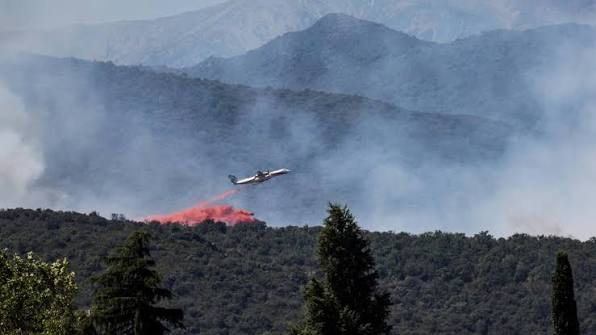
Heatwave fuels wildfire risk
The latest fires come as western Europe continues to experience exceptionally high temperatures following an intense early summer heatwave.
Forecasters say temperatures could once again reach 40 degrees Celsius in south-west France this week, while parts of Spain and Portugal have already exceeded that mark.
BBC Weather Lead Forecaster Matt Taylor warned that although current temperatures may not surpass those recorded during June’s historic heatwave, conditions remain highly unusual.
“Although this heatwave is unlikely to break records in the way June’s did, it will still be exceptional for the time of year,” he said.
He added that limited rainfall and persistent heat would keep wildfire risks elevated across the region.
Scientists have linked the increasing frequency and intensity of European heatwaves and wildfires to climate change. According to the Copernicus Climate Change Service, Europe is warming at roughly twice the global average, contributing to more frequent extreme weather events, prolonged droughts and devastating wildfires.


